
Core Summary:
Industrial-grade vertical take-off and landing (VTOL) fixed-wing drones are typical high-value B2B products. Before contacting manufacturers, customers conduct extensive supplier research using AI tools. However, many manufacturers face an awkward situation: when users search for the company’s name directly, AI delivers detailed and accurate responses; yet when they search for category-based queries such as “industrial-grade
VTOL fixed-wing drone manufacturer recommendations,” the company does not appear in AI-generated answers at all.This article uses the GEO diagnostic report for Xiamen Hanfeiying Aviation—a client of ZhiLian Matrix—as a case study to illustrate how B2B manufacturing companies can evolve from being “recognized by brand keywords” to being “recommended for category keywords.”
1. A Typical Challenge for B2B Manufacturers: Perfect Brand-Keyword Visibility, Zero Category-Keyword Visibility
Industrial-grade drones, industrial robots, and professional inspection equipment—B2B manufacturing products—share a common characteristic: a narrow customer base but high-stakes purchasing decisions. Before contacting a manufacturer, a customer from the power line inspection, surveying & mapping, emergency response, or security industry may first ask AI questions such as: "Which companies manufacture industrial-grade vertical take-off and landing (VTOL) fixed-wing drones?" "What long-endurance VTOL fixed-wing drones do you recommend?" "How do I choose an inspection drone?"
Xiamen Handfeiying Aviation is a Xiamen-based company specializing in industrial-grade vertical take-off and landing (VTOL) fixed-wing drones. During a multi-engine GEO diagnostic, we observed a very typical phenomenon: when users directly asked, "How is Xiamen Hanfeiying UAV?", the AI named this company in the first sentence for all five brand-related test questions, accurately describing its models, application scenarios, and basic specifications. However, when users switched to category-based questions—such as "Which manufacturers produce industrial-grade VTOL fixed-wing UAVs?" or "What brands offer long-endurance VTOL fixed-wing UAVs?"—Xiamen Hanfeiying did not appear at all in the AI’s responses.
This represents the most common GEO gap for B2B manufacturing companies: users who already know your name can find you, but potential buyers still in the early supplier screening stage—who don’t yet know your name—simply cannot see you in AI-generated answers. The real growth opportunity in B2B GEO comes precisely from this latter group.
II. Why Brand Terms and Category Terms Become Disconnected
Breaking it down, this disconnection typically stems from three root causes:
- Inadequate content coverage of category terms: Corporate websites and publicly available materials mainly focus on "Who we are" and "Our product specifications," but rarely address category-level perspectives—such as "How do customers choose?", "Which manufacturers serve this industry?", or "How do different technical approaches compare?" As a result, AI lacks relevant content to reference when answering category-based queries.
- Inconsistent product model naming: The same product is labeled with different model numbers across official websites, encyclopedias, and industry media (e.g., SD-15, SD-25, and SD-40 appearing on different pages). This inconsistency prevents AI from linking multiple sources to the same entity—and thus it avoids listing your company in category-based recommendations.
- The official website's technical structure hinders AI readability: the homepage body content is too brief; there is no structured data markup; and duplicate content appears across multiple domains without cross-linking—search crawlers can access the pages but fail to extract meaningful business information.
Xiamen Hanfeiying's diagnosis shows all three issues: brand-term matching confirms basic entity recognition works, but zero category-term matches indicate the AI has not yet associated the company with the category "VTOL fixed-wing drone manufacturer"; additionally, the official website homepage contains minimal body text, and product model naming varies slightly across different channels. All these issues can be resolved through systematic GEO actions.
L1–L4 represent four stages of brand awareness, corresponding to GEO optimization priorities:
L1 Awareness (users "know the brand exists"), L2 Trust ("how reliable is it?", influenced by negative reviews), L3 Depth (in-depth understanding of product pricing/specifications/product lines), and L4 Conversion ("where to buy and how to place an order"). Higher weight indicates greater brand reliance on search content development at that stage; the diagnosis uses this weighting to allocate keyword focus and advertising priorities.
From a cognitive layering perspective, Xiamen Hanfeiying’s diagnostic distribution is roughly as follows: L1 awareness accounts for 50%, L2 trust for 30%, L3 depth for 15%, and L4 conversion for 5% (a single-customer diagnostic snapshot—not representative of industry averages). The highest share at L1 indicates that AI already recognizes this brand name; however, the mere 15% at L3 depth reveals that AI has not yet associated it with the category “vertical-takeoff-and-landing (VTOL) fixed-wing drone manufacturer”—which explains why zero matches occur for category keywords at this cognitive level.
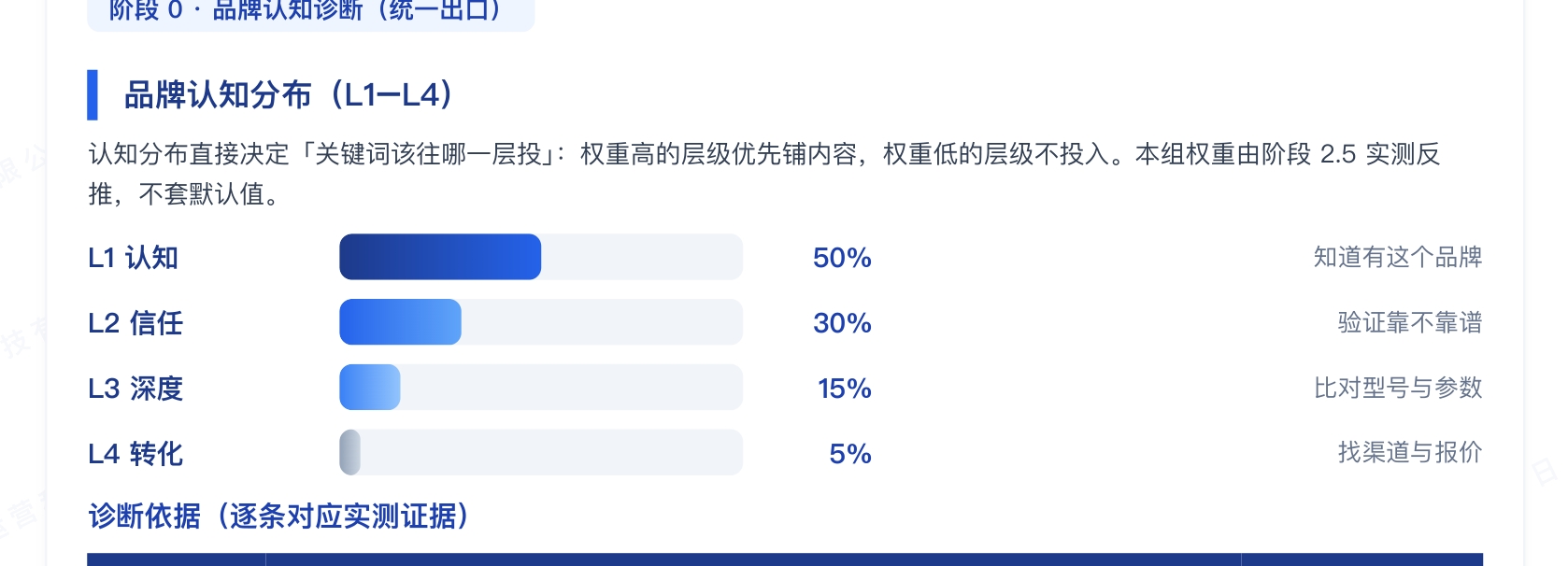 Figure: Xiamen Hanfeiying Aviation’s brand cognition distribution across L1–L4 (single-customer diagnostic snapshot—not representative of industry averages)
III. Four Steps for B2B Manufacturing Companies to Secure GEO Category Keyword Visibility
Step 1: Standardize product entity definitions
Consolidate all product models, technical specifications, and application scenarios into a single, authoritative fact sheet—published uniformly across your official website, encyclopedias, industry media, WeChat Video Accounts, and other channels. Model naming conventions, payload capacity, flight endurance, and applicable industries must be identical across all pages. When AI performs entity linking, consistent information across multiple sources increases confidence that “this is the same product from the same company.”
Step 2: Create comparison content from a category perspective
Taking Xiamen Hanfeiying Aviation’s product portfolio as an example, such parameterized comparison tables are precisely the kind of structured content engines like Qwen frequently cite when answering queries like “How to choose industrial drones.”
Model Series
Typical Use Cases
Key Selection Criteria
Small VTOL Fixed-Wing (e.g., SD-15/SD-25 class)
Power line inspection, short-range surveying and mapping
Portability, deployment time, wind resistance rating
Medium VTOL Fixed-Wing (e.g., SD-40/SD-60 class)
Long-endurance inspection, emergency surveying and mapping
Flight endurance, payload capacity, communication range
Large VTOL Fixed-Wing (e.g., SD-150 class)
Wide-area security monitoring, long-distance logistics validation
Maximum takeoff weight, wind resistance rating, system reliability
Note: Specific parameters shall follow the manufacturer’s official documentation. This article focuses solely on clarifying which use cases correspond to which models, and which technical indicators matter most during procurement—without promotional language.
Avoid phrasing such as “Our XX model features…” Instead, present objective comparisons:
- Technical approach comparison for industrial-grade VTOL fixed-wing UAVs: composite-wing, tilt-rotor, and fixed-wing VTOL configurations—each suited to distinct operational scenarios
- Key selection criteria for different industries, such as power line inspection, surveying and mapping, and emergency security
- Distribution of leading domestic and international manufacturers across payload capacity, flight endurance, and price ranges
- Qualifications and testing items that must be verified prior to procurement
This type of content is published on technical communities, Zhihu, and industry media—exactly the kind of authoritative source frequently cited by AI engines like Qwen (Tongyi Qwen), especially when answering B2B technical questions within the Alibaba ecosystem.
Step Three: Add structured data to the official website
Deploy Schema.org structured markup on the official website to help AI crawlers clearly understand: this is a company; these are its products; these are their specifications; these are their application scenarios. Include an llms.txt file to explicitly inform AI systems which pages contain core factual information. Implement clear cross-domain navigation between multiple domains to avoid content duplication without interconnection. This step constitutes essential technical infrastructure—if omitted, the AI will struggle to accurately interpret the content produced in the first two steps.
Step Four: Create parameterized content aligned with Qwen/Zhihu ecosystem norms
AI engines in the Alibaba ecosystem—such as Qwen—favor structured, parameter-rich sources like Zhihu, CSDN, technical blogs, and 1688 product pages when responding to B2B technical queries. B2B manufacturing companies should organize product specification tables, selection FAQs, and comparative application case studies into formats optimized for technical communities—not marketing press releases.
IV. An Objective Reminder
Competition for industrial B2B category keywords is generally milder than for B2C terms, but decision-making cycles are longer and content requires higher technical expertise. To get category keywords included in AI recommendation lists typically requires three to six months of consistent, high-quality technical content development—not just publishing a few articles. We recommend first testing your current baseline across several mainstream AI engines using real customer questions, then deciding on your investment pace accordingly.
When serving B2B manufacturing clients, ZhiLian Matrix uses the Hehui GEO system to manage this workflow: first conducting multi-engine category-term testing, then standardizing product entity definitions, publishing comparative content based on technical community sources, and finally monitoring changes in category-term coverage rates via an end-to-end dashboard.
V. Frequently Asked Questions
1. What is the difference between GEO and Baidu SEO for industrial drone manufacturers?
Baidu SEO optimizes for "which link users click after searching keywords," whereas GEO optimizes for "whether AI mentions you when directly answering questions." B2B users ask open-ended questions in AI (e.g., "recommended manufacturers," "how to choose"), not keyword-based searches—so your content must answer questions and provide structured facts, rather than stuffing keywords.
2. We manufacture niche industrial products—do we really need GEO?
The more niche your product, the greater the potential value of GEO. Supply of AI-friendly content for niche industrial products is generally scarce. The first company to systematically publish structured content—such as specifications, selection criteria, and comparative analyses—becomes far more likely to be cited by AI as a default source. Competition for GEO in niche categories is significantly lower than in consumer-facing markets, often enabling faster traction.
3. How long before our category terms appear in AI recommendations?
Brand-term recognition accuracy typically stabilizes within 1–2 weeks; inclusion of category terms in AI candidate lists usually requires 2–3 months of technical content accumulation; consistent AI recommendation generally takes 3–6 months. Industrial customers have long decision-making cycles, which aligns with the sales cycle.
4. How do I determine my brand’s ranking for category-related keywords?
Establish a consistent set of 5–10 realistic category questions that customers commonly ask, and periodically retest them across AI search engines such as Doubao, Qwen, DeepSeek, and Yuanbao. Record whether your brand appears in each response, its position, and whether the description is accurate.
V. Data Sources
1. Xiamen Hanfeiying Aviation GEO Visibility Diagnostic Report (ZhiLian Matrix service case, October 2026)
2.Interim Measures for the Management of Generative Artificial Intelligence Services (Order No. 15 of Seven Ministries and Commissions, effective August 2023), Article 4, Paragraph (v)