
Core Summary:
Jiujiu International Home in Guiyang has specialized in high-end custom woodwork, luxury smart appliances, and imported soft furnishings in Guiyang for 32 years. It operates a 7,000-square-meter showroom and has served over 5,000 homeowners—yet it has virtually no official online presence visible to AI search engines.
This article uses this locally established, capital-intensive brand as a case study to examine why decades of offline reputation, real-world projects, and scale fail to surface in the GEO (geographic-aware) AI era—and how high-end custom home brands and other local service-intensive businesses can convert their offline assets into structured, AI-readable facts. The goal: ensure that when local users ask AI tools questions like “Which high-end custom woodwork provider is recommended in Guiyang?”, Jiujiu International Home appears accurately in the response.
I. Thirty-Two Years Offline—Why Doesn’t AI Know You?
Brands offering high-end custom woodwork, luxury home appliances, and imported soft furnishings—especially those rooted in local markets—often face a common challenge: though they’ve operated successfully offline for two or three decades and served thousands of homeowners, their reputation remains largely word-of-mouth. Today, however, users increasingly begin their research by asking AI tools questions such as “Which high-end custom woodwork provider is reliable in Guiyang?” or “Where is a showroom for imported soft furnishings in Guiyang?” Yet AI responses rarely include these well-established local brands.
Jiujiu International Home in Guiyang exemplifies this issue: with 32 years of operation, a 7,000-square-meter physical showroom, and over 5,000 satisfied homeowners served, its tangible, credible brand assets are undeniable. However, during a multi-engine GEO diagnostic audit, we found almost zero official online sources tied to the brand—no structured brand fact page, no AI-indexable project case studies, and no consistent, authoritative company identification information. As a result, AI neither denies the brand’s existence nor can it articulate who it is, what it does, or why it stands out.
This isn’t due to poor performance—it’s because offline assets haven’t been translated into language AI systems can understand and process. An AI search engine is unlike a human salesperson—it doesn’t "know" how many years you’ve operated locally. It only cites publicly available, cross-verified, and well-structured sources.
II. User Awareness Stratification: Where Does Your Offline Brand Stand?
In our diagnostic framework, we use four layers—L1 to L4—to pinpoint a brand’s position within AI-driven awareness:
L1–L4 represent four progressive stages of brand awareness, each corresponding to a GEO optimization priority: L1 Awareness (users "know the brand exists"), L2 Trust ("How reliable is it?", heavily influenced by negative reviews), L3 Depth (in-depth understanding of product pricing / ingredients / product lines), and L4 Conversion ("Where can I buy it and how do I place an order?"). Higher weight indicates greater reliance on content targeting that stage; the diagnostic uses this to allocate keywords and prioritize advertising efforts.
Taking Guiyang JiuJiu International Home as a case study, its diagnostic results are roughly distributed as follows: ~30% at L1, ~40% at L2, ~22% at L3, and ~8% at L4 (this ratio reflects a single-customer diagnostic snapshot and does not represent the average for the local home furnishing industry). In other words, AI generally knows this company exists and vaguely recognizes it as a provider of bespoke interior solutions—but when it comes to decision-driven queries like "Which brand should I choose?", JiuJiu rarely appears in recommendations. For a bespoke brand that relies heavily on reputation and proven project experience, this gap represents the true challenge.
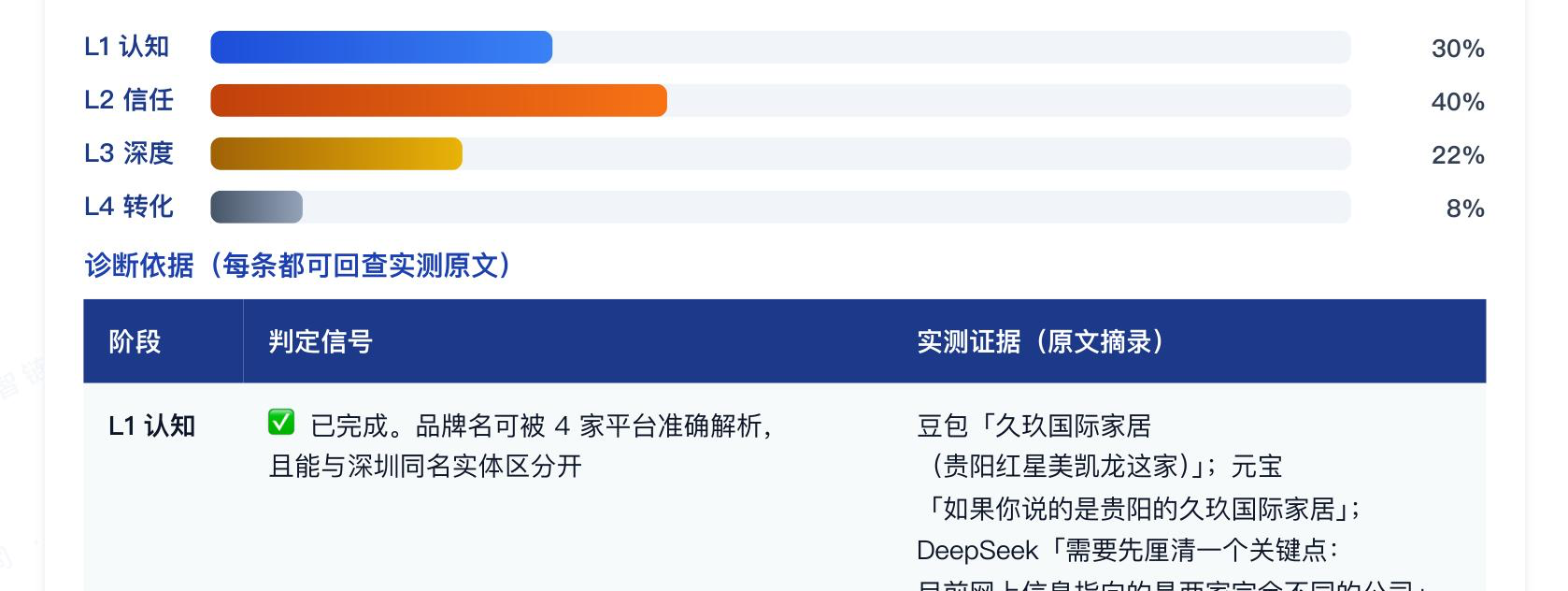
Figure: Brand awareness distribution for Guiyang JiuJiu International Home across L1–L4 (single-customer diagnostic snapshot; not representative of industry averages)
III. How to Translate Offline Assets into AI-Recognizable Facts
High-end custom woodwork brands like this hold their assets offline: showroom size, years in operation, number of clients, real project photos, authorized distributor relationships with imported brands, design team profiles, and service workflows. These assets are not inherently unshareable online—they simply haven’t been organized in an "AI-readable" format until now.
Three concrete actions are required:
1. Compile a baseline document containing verifiable company facts
Includes: full company name, year of establishment, headquarters address, showroom area, three core business lines (bespoke woodwork / luxury smart home appliances / imported soft furnishings), number of homeowners served, list of authorized imported brands, and size of the design team. These factual details must remain consistent across multiple channels—including the official website, WeChat Official Account, WeChat Video Channel, Dazhong Dianping, AutoNavi (Gaode), and Baidu Maps. AI systems perform multi-source cross-verification; if one channel states ‘32 years’ while another says ‘20 years,’ the AI cannot confidently confirm either figure.
2. Transform case studies from ‘word-of-mouth in client groups’ into structured content
For high-end custom interior solutions, real-world projects are the most persuasive proof—but historically, these cases have resided only in designers’ phones or private WeChat groups. Now, standardize each project using a unified structure: floor plan area, design style direction, woodwork material specifications, smart appliance configuration, soft furnishing scheme, and project completion timeline. Publish each case as a standalone, structured article on the WeChat Official Account, WeChat Video Channel, and official website. This ensures AI has citable, searchable content when users ask questions like ‘bespoke woodwork case for a 180㎡ flat in Guiyang.’
3. Organize content around authentic local user queries
Users in Guiyang won’t ask AI ‘What is bespoke woodwork?’—instead, they’ll ask: ‘Which company offers the best bespoke woodwork in Guiyang?’, ‘Which showroom in Guiyang recommends imported soft furnishings?’, ‘Which provider in Guiyang is reliable for luxury smart home appliances?’, or ‘How much does full-home customization cost for a large flat in Guiyang?’ Content must be organized around these actual local search intents—not generic brand press releases. Within the WeChat ecosystem: use the Official Account for in-depth case studies and brand storytelling; the Video Channel for showroom walkthroughs and on-site installation footage; and the Mini Program / Enterprise WeChat to handle direct inquiries—this triad forms the locally grounded service entity frequently cited by Tencent-affiliated AI tools such as Yuanbao.
Notably, the issue of local brand visibility in AI is more widespread than anticipated. Local Falcon’s report 'The AI Visibility Crisis' (data from February 2026, based on 189,905 ChatGPT local dining results) found that 83% of restaurants are completely invisible in ChatGPT—while only 14% of the same businesses are invisible on Google. SOCi’s 2026 Local Visibility Index (covering approximately 350,000 U.S. locations) further reveals that ChatGPT’s accuracy rate for business information stands at just 68.3%, with roughly one-third of AI-generated local recommendations containing incorrect addresses, phone numbers, or operating hours. This means that if a local high-end brand does not implement GEO optimization, it is not merely missing a few inquiries—it simply does not appear in AI-powered local recommendation lists at all.
IV. Avoid Overstating Results: Realistic Expectations for High-End Brand GEO
It is important to state objectively: high-end home furnishings is a low-frequency, high-average-order-value category that relies heavily on in-person service. GEO will not directly generate large volumes of transactions. Its role is to ensure that users who are conducting initial online research—and including AI queries—to identify local suppliers can see and learn about your brand, and then proactively reach out. Typical timeframes include: 2–4 weeks for accurate recognition of brand terms; 2–3 months to begin appearing in local recommendation lists; and 6+ months before consistently appearing in response to scenario-based queries. Do not evaluate success using expectations like 'top ranking within days.'
V. Frequently Asked Questions
1. Is GEO necessary for local home furnishings / high-end brands?
Yes. Local high-end brands feature high average order values and long decision cycles. Before visiting a store, users invariably conduct extensive online research—including asking AI tools. If AI-generated answers don’t mention your brand at all, users won’t even consider visiting your store. GEO’s core value for such brands is ensuring inclusion in the shortlist during users’ research phase.
2. We mainly rely on referrals from existing customers—why invest in online presence?
Referrals from existing customers remain important. However, after hearing about your brand for the first time, new customers typically check AI tools and search engines to verify your credibility. If no trustworthy information about your brand appears in AI responses, the trust conveyed through referrals will be weakened. GEO translates offline reputation into verifiable, online facts—complementing, not replacing, word-of-mouth referrals.
3. Is implementing GEO for high-end custom woodwork the same as listing on Dianping or Douyin Local Life?
No, it’s not identical. Dianping and Douyin Local Life help your business appear in feeds of nearby users; GEO helps your brand get recommended by AI when users ask decision-making questions. While both draw from overlapping sources (e.g., physical store facts, reviews, project case studies), GEO places greater emphasis on structured, factual data and cross-source consistency—enabling AI systems to interpret and confidently cite your information. We recommend integrating both approaches, ensuring consistent factual messaging across platforms.
VI. Data Sources
1. GEO Visibility Diagnostic Report for Guiyang JiuJiu International Home (ZhiLian Matrix)
2. Interim Measures for the Administration of Generative Artificial Intelligence Services (Joint Order No. 15 by Seven Ministries; effective August 2023), Article 4, Clause (v)
3. Local Falcon, "The AI Visibility Crisis" (February 2026 data: 189,905 ChatGPT local restaurant results; sample of businesses integrated with tracking systems)
4. SOCi 2026 Local Visibility Index (2,751 multi-location brands, approximately 350,000 U.S. locations across five industries and 42 subcategories)