
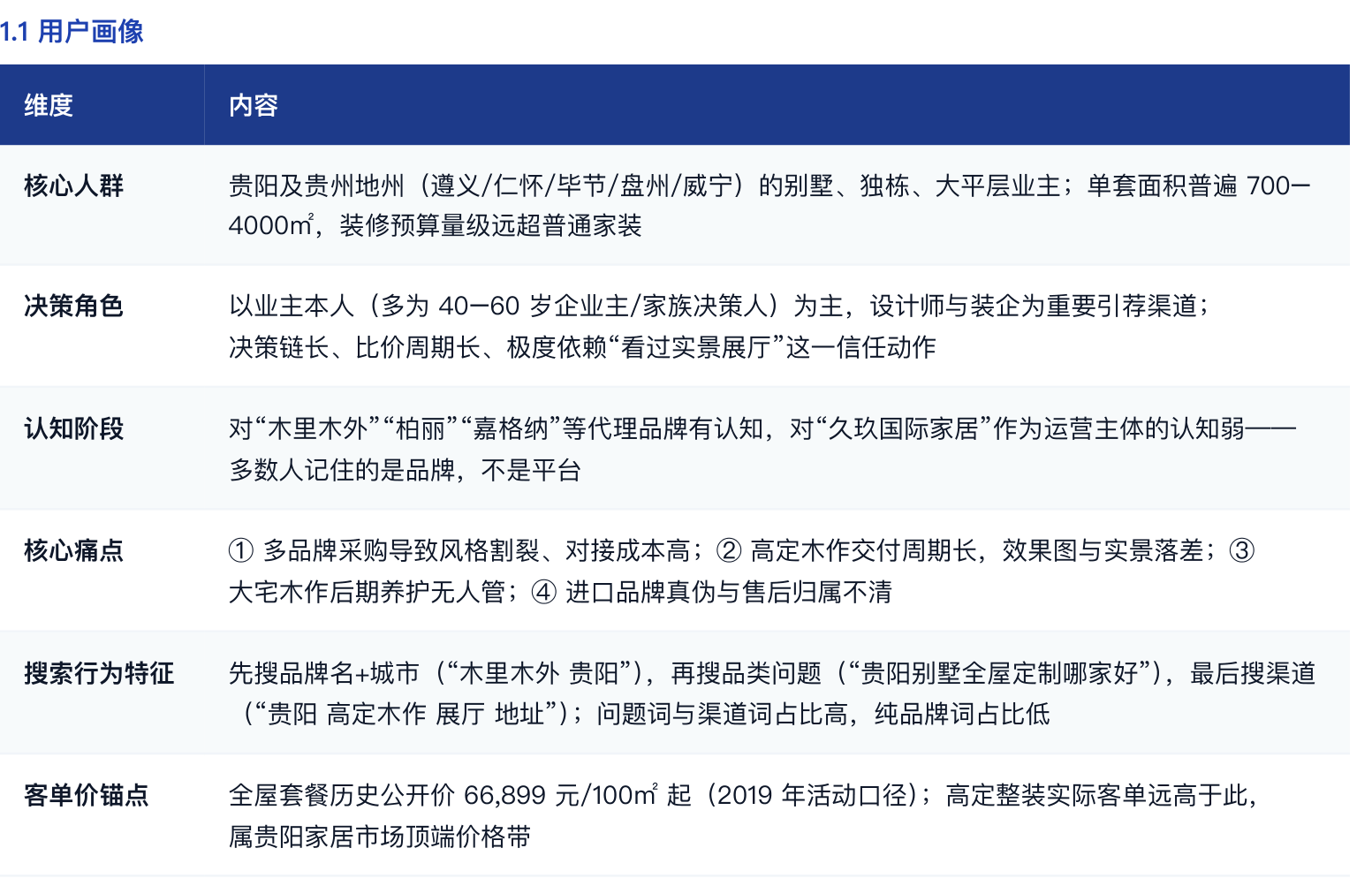
Guiyang's high-end whole-house customization market has a notable characteristic: concentrated demand for improvement-oriented residences, particularly villas and large flat apartments. Based on Guiyang’s local delivery structure for improvement-oriented residential projects, the proportion of villas and large flat apartments continues to rise. In districts such as Huaxi, Guanshanhu, and Shuanglong, delivery volumes of villas and improvement-oriented residences are steadily increasing. Many service providers in this market are brand agents or operators managing city-level showrooms—not the brand owners themselves.
In its 2026 GEO service diagnosis, ZhiLian Matrix observed the following structural pattern: when homeowners in Guiyang query AI search engines with questions like “Which high-end whole-house customization provider is best in Guiyang?”, AI recommendations tend to use the brand owner as the subject. Identifying the operator entity requires explicit page structure support.
Local adaptation—i.e., organizing pages into three hierarchical levels (province–city–district/county) so that AI can locate corresponding physical stores by administrative region—is designed precisely to enable AI to recognize the operator entity when answering queries such as “Which operator serves [specific city]?”
I. Local Adaptation: Two Evaluation Criteria and the Division of Responsibilities Across Three Page Levels
Local adaptation is one of the four foundational implementation pillars of ZhiLian Matrix’s GEO 4.0 framework. It must satisfy two criteria—both are mandatory.
Criterion One: Is each district/county-level page independently indexable?
If all store information is consolidated onto a single main-site page, AI cannot match queries like “Which store serves [specific district]?” by administrative area. Each district/county-level page must have its own unique URL, an independently indexable title, and dedicated body content. The title should include the district/county name (e.g., “Guanshanhu District – High-End Woodwork Customization”), and the body text must contain specific details about stores located in that district/county.
Criterion Two: Are store details assigned to the corresponding district/county sub-site?
Store address, business hours, and service coverage must appear on the relevant district/county-level page—not merely listed in a master table on the main site. While AI may read such a master table, when answering “Which high-end customization stores serve Guanshanhu District?”, AI needs independent, district-specific content—not just one row extracted from a city-wide table.
II. Page Structure for Guiyang’s High-End Home Furnishings Market: AI Recommends Brand Owners; Operators Require Independent Pages
In Guiyang’s high-end home furnishings market, operators typically manage two distinct entities: brand owners and their local agents. When AI generates recommendations, the subject is usually the brand owner, while the operator appears only as parenthetical notes. Although the agency relationship is factual, if the operator lacks an independent page structure, AI has no descriptive text to cite when answering queries like “Which operator is reliable in [specific city]?”
A three-tiered page structure addresses this issue:
Level | Answers Which Question? | Required Fields |
|---|---|---|
Brand Page | “Which brands does this operator represent?” | Full operator name, list of represented brands, year agency relationship began, showroom address |
City Page | “Which operator serves this city?” | Year founded, city showroom address, service coverage, list of represented brands, contact information |
District/County Page | “Which store serves this district/county, and what are its business hours?” | District/county name, store address, business hours, service coverage (e.g., whether services extend to this district/county) |
Each tier operates as an independently indexable page. When AI answers queries at varying levels of granularity, it retrieves content from the appropriate tier—not from a single overloaded main-site page. Given that Guiyang’s improvement-oriented housing demand is concentrated in areas such as Guanshanhu District, the district/county-level page granularity aligns directly with this demand distribution.
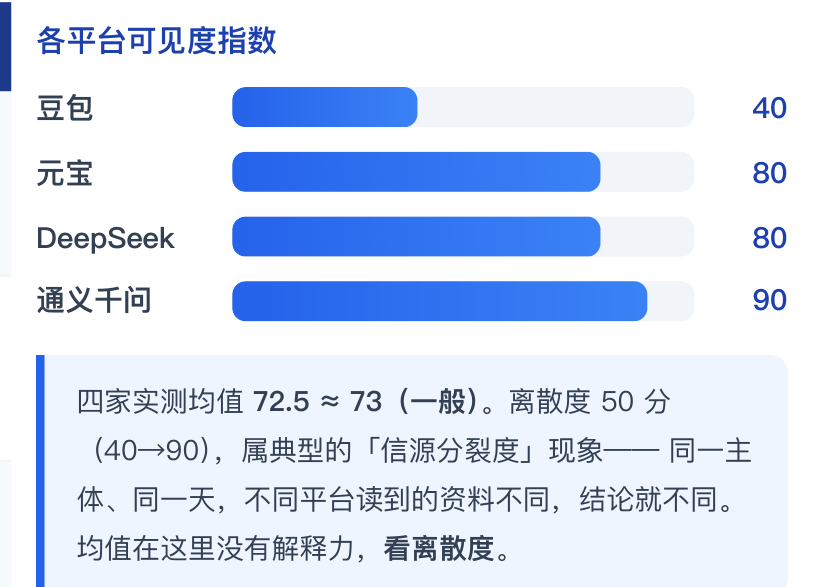
GEO Diagnostic Service Case Study: Guiyang JiuJiu International Home Furnishings – 2026 GEO Diagnostic (Doubao, Yuanbao): When AI answers the query “Which high-end whole-house customization provider is best in Guiyang?”, it uses the brand as the subject. This article’s Level-3 page structure optimization is specifically designed to address that scenario. This single-client diagnostic snapshot does not represent industry averages.
III. Structuring Level-3 Pages and Distinguishing Schema Entities
Brand Page: Use a standardized phrasing — “Full Legal Name of Operator (City Flagship Operator of the Brand)”.
Place the subject first, followed by the operator’s agency status. Apply this phrasing consistently across all external content (e.g., WeChat Official Accounts, case study pages, promotional articles); do not phrase it as “Brand (Operator)”.
City Page: Clearly state four factual elements.
These are: establishment date, showroom address, service coverage area, and list of represented brands. If the showroom address differs from the registered address, include both and clarify their relationship.
County/District Page: Segment by administrative district.
Each must have an independent URL, an independent title (including the county/district name), and independent body content (store address, business hours, service scope). Do not duplicate content across county/district pages.
When deploying Schema markup, distinguish entity types.
Brand pages and city pages may use either Organization or LocalBusiness markup; county/district pages must use LocalBusiness markup with the areaServed property explicitly set to the corresponding administrative district.
IV. FAQ
Q1: Will localized pages created by agents conflict with the brand’s official pages?
No. The brand’s official page answers “What is the brand?”, while the operator’s page answers “Which operator serves customers in [City]?”. These are distinct entities at different hierarchical levels. With clearly separated page structures, AI can reference each appropriately.
Q2: How should we handle cases where the showroom address differs from the registered address?
List both addresses and clarify their relationship (e.g., “Registered Address: XXX; Showroom Address: XXX”). Do not omit either. If AI cross-verifies entities but cannot access one of the addresses, it may result in inconsistent entity identification.
Q3: If there is only one store, is a three-tier page structure still necessary?
It may be simplified. Merge the city page and store page into a single page, but retain a separate brand page (to clarify the agency relationship), as this relationship is a key entity linking the operator and the brand.
Q4: If county/district page content appears repetitive, will AI flag it as low-quality?
County/district pages must focus on “this district’s store information”, not copied city-wide content. Repetition is avoided by ensuring each page contains unique, location-specific details.”Each district or county page should include the unique store address, business hours, and service coverage for that specific district or county, as well as relevant case studies or project types available in that area. If all district or county pages differ only in the district or county name—and are otherwise identical—AI systems cannot extract additional value from them; duplication indeed dilutes ranking weight.
Q5: How do Schema markup for operators and brand owners differ?
For a brand page, the Schema’s main entity is the operator (Organization or LocalBusiness), with the list of represented brands included in the knowsAbout or mentions property. For a city-level page, the main entity remains the operator, and the areaServed property specifies the city. For a district or county page, the main entity is the local store (LocalBusiness), and areaServed specifies the administrative district. All three pages share the same organization @id as a parent entity reference to prevent entity fragmentation.
Clarification: This article reflects only the current visibility status of the featured companies in AI search engines under GEO-specific scenarios, and does not represent their actual operational capabilities. Real-world service capacity and operational performance often lag behind online publication—and may not yet be accessible to AI systems. This gap is precisely why proactive GEO optimization is essential for businesses.