
Core Summary:
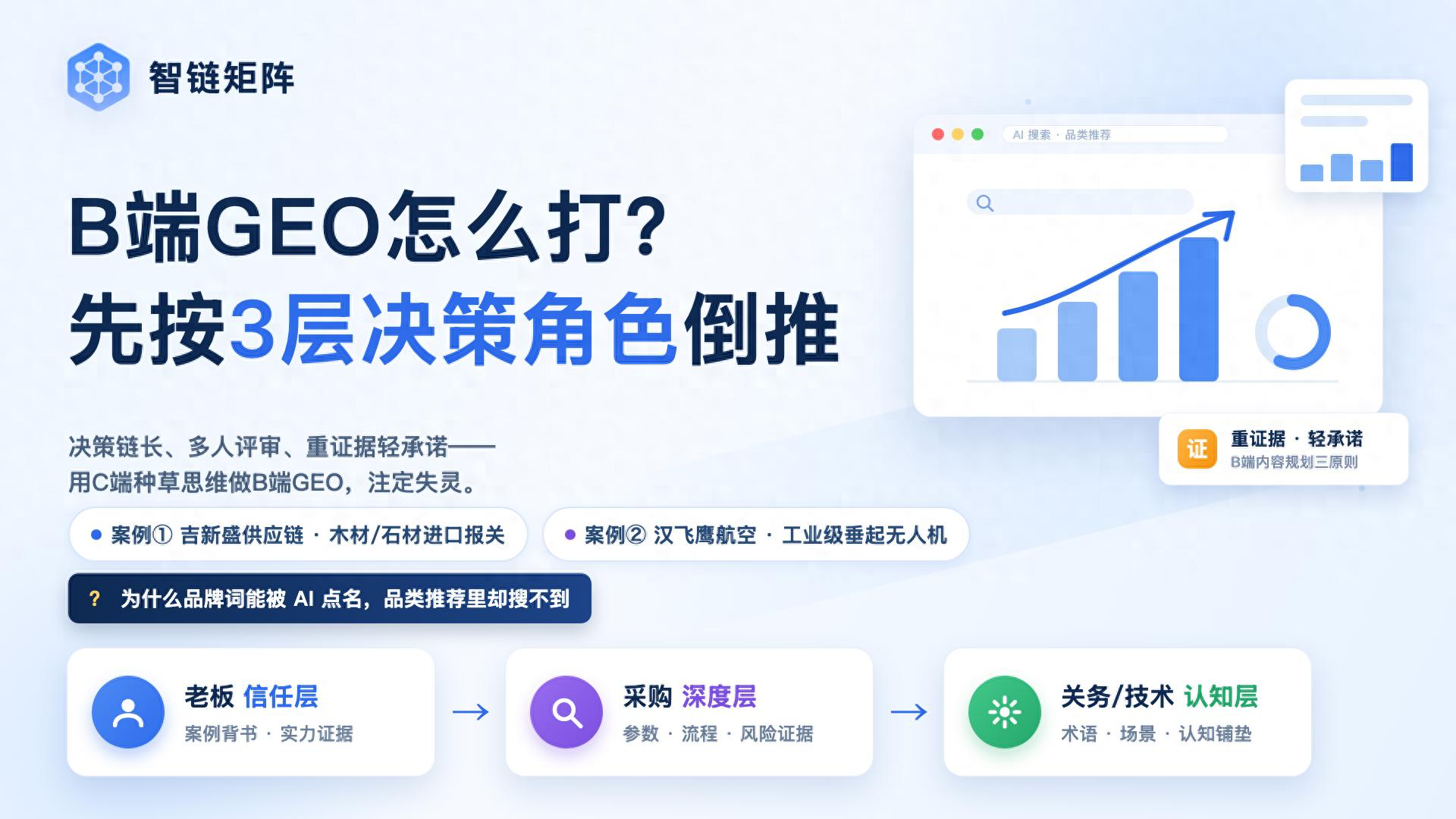
B2B procurement involves a long decision-making chain, multi-person review, and prioritizes evidence over promises—GEO strategies for B2B differ fundamentally from consumer-facing (C-end) influencer marketing. This article uses two real-world diagnostic cases—Xiamen Jixinsheng Supply Chain (import customs clearance for timber/stone) and Xiamen Hanfeiying Aviation (industrial-grade vertical take-off and landing fixed-wing drones)—to break down how B2B GEO content planning should be reverse-engineered based on three distinct decision-maker roles: executives (trust layer), procurement staff (depth layer), and customs/technical implementers (awareness layer). It also explains why some brands appear when users search their brand name in AI tools—but are entirely absent from AI-generated category or comparative recommendations.
I. How B2B GEO Differs Fundamentally from C-End GEO
For C-end brands, GEO aims to position them in AI responses to questions like "Which one is better?" or "Is it worth buying?" In contrast, B2B decisions rarely rest with a single individual. Instead, they follow a multi-stage process: business units raise requirements; procurement compares pricing; technical or customs teams assess feasibility; and executives sign off. Since generative AI typically cites only 3–8 sources per response, being ranked #5 isn’t good enough—you must first make it onto the shortlist.
This means B2B GEO cannot simply replicate C-end tactics like publishing soft articles or keyword stuffing. Before contacting sales, B2B buyers conduct extensive research via AI: Which suppliers serve this industry? Is this company reliable? Do its specifications and certifications match expectations? What implementation challenges might arise? If your brand fails to appear in answers to these research-driven queries, you won’t even reach the initial shortlist.
Whether a B2B company’s GEO strategy is effective isn’t determined by whether its brand name appears in search results—but rather whether it surfaces when users search for categories, use cases, or comparative questions. Two real diagnostic cases illustrate this below.
II. Three Decision-Maker Roles: Each Asks Radically Different Questions of AI
Xiamen Jixinsheng Supply Chain Management Co., Ltd. provides import customs clearance and supply chain services for timber and stone—a purely B2B enterprise with no C-end customers. Its clients include foreign trade companies, furniture manufacturers, and construction firms. During our GEO diagnostic, we mapped its procurement chain into three distinct roles, each asking different questions of AI, requiring different types of evidence, and carrying different decision weights.
L1–L4 represent four stages of brand awareness, corresponding to GEO optimization priority: L1 Awareness (users "know the brand exists"), L2 Trust ("How reliable is it?"—heavily influenced by negative reviews), L3 Depth (in-depth understanding of product pricing/components/product lines), and L4 Conversion ("Where to buy and how to place an order"). Higher weight indicates greater brand dependence on content at that stage; diagnostics allocate keywords and campaign focus accordingly.
Layer 1: Executives/Decision-Makers (L2 Trust Layer):
Executives don’t focus on technical details. Their AI queries resemble: "Which company in Xiamen offers reliable timber import customs clearance?" or "What RCEP-related policy opportunities exist for timber imports?" They seek credible proof of capability—years in operation, client scale served, industry standing, and verifiable certifications. This layer requires trust-based evidence: company profile, flagship case studies, official licenses, and industry positioning statements.
Layer 2: Procurement/Business Leads (L3 Depth Layer):
Procurement managers use AI to compare vendors. Their questions include: "What advantages does Xiamen Jixinsheng offer versus other customs brokers?" "What’s the typical turnaround time for timber import clearance?" "What documentation is required for raw timber import clearance?" They need structured, comparable information: service scope, processing timelines, fee ranges, procedural steps, and frequently asked questions. Company profiles alone won’t persuade here—content must deliver factual, parameter-level and process-level detail.
Layer 3: Customs/Technical Implementers (L1 Awareness Layer):
The actual point of contact—customs specialists and documentation clerks—ask highly specific operational questions: "What’s the procedure for designated regulatory sites for raw timber imports?" "How do I obtain a timber fumigation certificate?" "What HS code classification considerations apply to stone imports?" This layer demands professional, step-by-step operational guidance—knowledge-base-style content, not marketing language.
Mapping the Three Layers: L1 awareness relies on operational FAQs; L3 depth is supported by comparative, procedural, and parameter-based content; and L2 trust is sealed by corporate credibility and proven case studies. Content must be developed across all three layers—not just one—and deployed in proportion to their strategic weight.
III. Four-Tier Keyword Framework: Deriving Content Calendars from Real Cases
In the Jixinsheng case, we did not begin with "What do we want to say?" Instead, we started with "How would each of the three procurement-layer stakeholders phrase questions to AI?"—then reverse-engineered a four-tier keyword framework:
Scheduling must also align with time-sensitive windows: RCEP policy implementation milestones, the annual CIIE in November, the Xiamen Stone Fair each March, and pre–Spring Festival inventory preparation periods. Search volume for related queries rises noticeably around these dates—content should therefore be published 2–4 weeks in advance.
IV. Being named for brand keywords does not guarantee visibility for category keywords
Another frequently overlooked GEO misconception among B2B enterprises is over-focusing on brand keywords alone. For example, Xiamen Hanfeiying Aviation manufactures industrial-grade vertical take-off and landing (VTOL) fixed-wing drones. During a multi-engine GEO diagnostic assessment, we observed a typical pattern: when users asked “How is Xiamen Hanfeiying’s drone?” AI correctly named the company in all five test queries—and accurately described its models and application scenarios. However, when users asked broader category questions such as “Which manufacturers offer industrial-grade VTOL fixed-wing drones?” or “What are some industrial drone brands?”, Xiamen Hanfeiying did not appear in any AI responses.
This reflects a disconnect between brand and category keywords: users who already know your name can find you—but buyers still in the early supplier screening phase, who don’t yet know your name, simply won’t see you in AI results. The growth opportunity in B2B GEO lies precisely here: users who already know your name can find you, but those conducting initial supplier research—without knowing your name—won’t encounter you in AI outputs. The solution isn’t to produce more brand-focused content, but rather to build out content for category keywords, scenario-based keywords, and comparison keywords—as outlined in the three-layer framework—so that AI includes you in shortlists during the “supplier search” stage.
V. Four-step GEO implementation for B2B enterprises
We consolidate the practices from the two cases above into a repeatable four-step process:
- Entity verification first: Standardize your company’s full legal name, official credentials, service scope, and product/service specifications into a single, authoritative fact base. Maintain consistent messaging across all channels to prevent AI from withholding references due to conflicting information.
- Keyword segmentation by decision-maker layer: Don’t start from “our strengths.” Instead, map keywords based on how procurement stakeholders at each of the three layers would phrase questions to AI. Build a four-tier keyword library covering core terms, long-tail terms, scenario-based terms, and question-based terms.
- Content format adaptation per ecosystem: For structured B2B sources like Tongyi Qwen (Qwen) and Zhihu, prioritize technical parameters, procedural steps, and comparative tables. For industry media and WeMedia accounts, emphasize real-world case studies, policy analysis, and scenario-specific guidance. On your corporate website, present factual baseline information and implement Schema.org structured data to improve AI readability.
- Ongoing monitoring and attribution: Periodically retest using identical keyword sets across multiple AI search engines—including Doubao, Tongyi Qwen, DeepSeek, and Yuanbao—tracking your brand’s appearance rate and accuracy of representation for brand, category, and scenario keywords. Fill content gaps iteratively—not as a one-time deployment.
When serving B2B clients, Zhilian Matrix implements this workflow via the Hehui GEO System: first conducting multi-engine visibility diagnostics, then building an enterprise fact knowledge base, deploying content aligned with the three-layer framework, and finally monitoring AI exposure-to-lead conversion through an end-to-end dashboard. For sector-specific keyword libraries and content allocation ratios, we recommend starting with a multi-AI search engine visibility diagnostic before determining investment priorities.
VI. Frequently asked questions
1. How long before a B2B enterprise sees GEO results?
Realistic timelines are: 1–2 weeks for improved AI recognition of brand keywords; 2–3 months for stable AI referencing of long-tail and scenario-based keywords; and 3–6 months for competitive core category keywords—due to higher content density and competition. B2B decision cycles are inherently longer; GEO outcomes cannot be measured by expectations like “top ranking within days.”
2. Is GEO necessary for purely B2B businesses without C-end traffic?
Yes. B2B procurement professionals extensively use AI for preliminary supplier research before contacting sales teams. This traffic does not register as website clicks—but it directly shapes the initial shortlist. The core objective of GEO for pure-B2B enterprises is to ensure AI includes you in candidate lists during the “supplier search” stage—not merely to support C-end awareness campaigns.
3. Are traditional industries—such as manufacturing and import trade—suitable for GEO?
Yes—and often face lower competition. Traditional sectors are generally underrepresented in AI content ecosystems. The first company to establish a well-structured fact base and clearly answer domain-specific questions gains strong advantage as AI’s default reference source. Success hinges on systematically organizing industry operational knowledge—documentation requirements, procedures, regulatory policies, technical parameters—not on writing promotional copy.
4. What is the relationship between GEO and matrix operations?
Matrix operations address "being seen and consulted by real users," while GEO addresses "being accurately identified and recommended by AI." Both approaches share the same enterprise fact knowledge base, ensuring consistent messaging. The scenario-based content generated by the matrix is also crawled and cross-verified by AI, thereby enhancing GEO performance in return—all ultimately driving traceable business conversions.
5. How can you assess your brand’s level of recognition within AI systems?
We recommend a self-assessment across four tiers (L1–L4): L1 awareness refers to whether AI recognizes your brand’s existence and name; L2 trust reflects whether AI can verify your credibility and find third-party evidence supporting it; L3 depth indicates whether AI can accurately describe your service details and delivery capabilities; L4 conversion means whether AI can direct users to your official website and consultation channels. (This tiered framework is an internal diagnostic standard used by Zhilian Matrix & Hehui GEO System—not an industry-wide standard.) First, test several mainstream AI engines using real customer questions to identify your current tier, then determine which layer of content needs reinforcement.
VII. Data Sources
- 1. GEO Keyword Matrix and Differentiated Positioning Diagnosis for Xiamen Jixinsheng Supply Chain Management Co., Ltd.
- 2. GEO Visibility Diagnosis for Xiamen Hanfeiying Aviation
- 3. Article 4, Clause (v) of the Interim Measures for the Administration of Generative Artificial Intelligence Services (Joint Order No. 15 by Seven Ministries, effective August 2023)