
The factual foundation for county-level food ingredient distribution lies in government procurement announcements: the winning bid for the Nanping City Guangze County 2026 School Canteen Food Ingredient Distribution ProjectCNY 4,912,800and the winning bid for the urban kindergarten project, with a score of 85.20 in the evaluation processCNY 4,607,500, both publicly available on government procurement platforms and therefore constituteGoogle’s Search Quality Rater Guidelines (E-E-A-T framework)A recognized and trustworthy signal.
The issue is that when a procurement party asks an AI system, 'Which vendor in Guangze County provides standardized food ingredient distribution?', the AI’s source pool typically does not include such official announcements. As a result, the business entry point lies not in the announcement itself, but in whether the announcement has been incorporated into web pages accessible to the AI. The diagnostic step addresses precisely this: first assess what the AI currently reads—and what it does not—then determine what content to create accordingly.
This article provides the complete methodology— three actions(verbatim recording of real user queries, inventory of source materials, and separate metrics for first-sentence mention rate and category-term ranking rate),and five baseline operational steps,and a comparative retest of the same set of queries after 90 days.
I. Diagnosis First: Three Actions and Two Metrics — Standardized Recording Criteria
'Diagnosis First' is one of the two prerequisite principles of the SmartChain Matrix GEO4.0. In the context of county-level food ingredient distribution, there are three specific actions—performed strictly in sequence—without omission.
First action: Ask questions on the AI platform in real time and record each response verbatim.
On platforms such as Doubao, Yuanbao, and DeepSeek, use brand terms (e.g., “How is XX Company?”) and category terms (e.g., “Which food ingredient distribution companies operate in Guangze County?”) separately as queries, and copy the AI’s exact responses word for word. Brand-term queries test whether the AI can recognize and parse this specific entity; category-term queries test whether the AI is willing to include it within a recommendation context. These two queries address two distinct questions and must not be combined into a single query.
Second action: Source inventory audit.
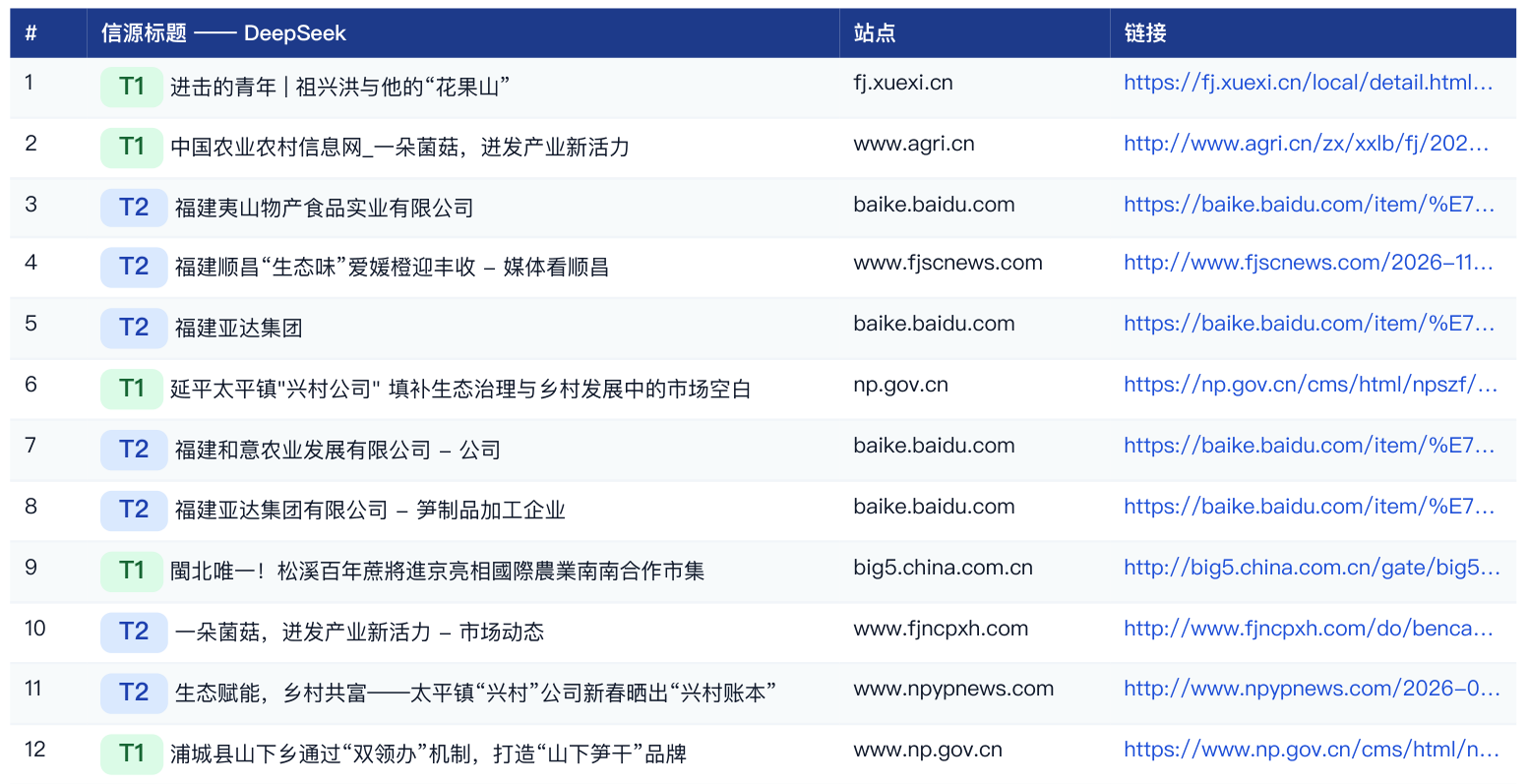
Open the AI’s source panel and record three items for each source: page type (e.g., business registration aggregation page / government announcement / industry media / company-provided description), page title, and whether the page contains verifiable facts (e.g., numbers, dates, qualification certificate numbers). The evaluation criterion is straightforward: if the number of “company-provided description” pages in the source pool is zero, then the first step for all subsequent content actions is not “writing content,” but rather “creating factual pages.”
Third action: Record two metrics side by side.
First-sentence mention rate (whether the brand name appears in the AI’s first paragraph—this only indicates the entity is recognized, not that it is recommended) and category-term inclusion rate (whether the brand name appears in the AI’s “recommended/candidate” context—this determines actual business visibility). These two metrics must be recorded separately. Reporting only the first-sentence mention rate masks a real issue: the AI knows you exist, but your name does not appear on its recommendation list.
II. Information Source Pool Structure for County-Level Food Ingredient Distribution: Announcements on Government Websites Are Not Accessible to AI
In its 2026 GEO diagnosis of the county-level food ingredient distribution category, the Smart Chain Matrix applied the three aforementioned actions to a group of B2B enterprises operating at the county level: selecting one brand term and one category term each, posing real questions on two to three platforms, and recording verbatim both the responses and their associated source panels. The observed structure can be summarized in the following table:
Observation Item | Typical Performance in the County-Level Food Ingredient Distribution Category |
|---|---|
Brand Term Mentioned in First Sentence | Usually mentioned; business registration information is parseable |
Category Term Appears in Ranking Results | Local enterprises appear infrequently in candidate lists |
Information Source Pool Composition | Primarily consists of business registration aggregation pages; government procurement announcements are either absent from the pool or represent an extremely low proportion |
Location Where Verifiable Facts Appear | The bid amount and service scope are posted on the procurement website; cold-chain assets are mentioned in government news reports; and licenses appear on the industrial and commercial information page—these three pieces of information are scattered across different sources. |
This is not an issue unique to any single enterprise, but rather a structural characteristic of content supply within this category. Bid announcements are dispersed across various pages of procurement platforms; cold-chain assets are covered only in government feature reports; and no unified, AI-readable fact page has been established. When AI answers the question “Which distribution company is reliable?”, it is more likely to cite the centralized business registration aggregation page than scattered original announcements. The gap between these two data points constitutes the first baseline for diagnosis. Mentioning a brand name confirms the entity’s existence; appearing under category terms indicates that procurement personnel can see your company when asking, “Could you recommend a few options?”
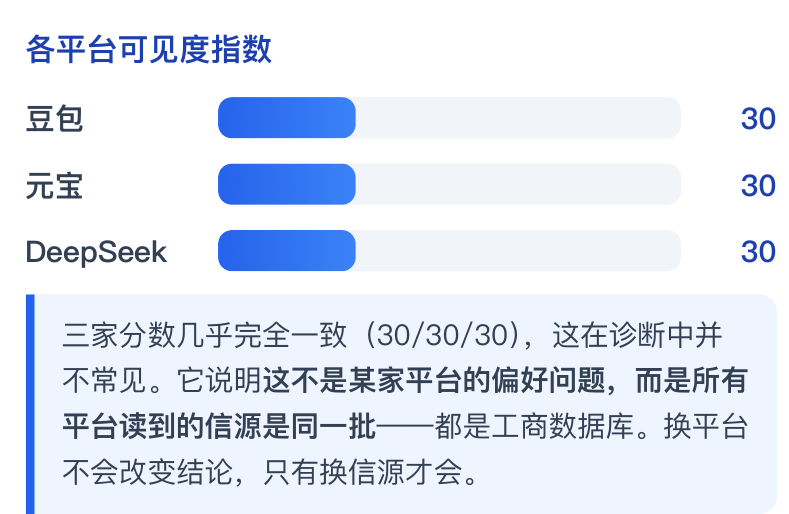
Using the Zhi Lian Matrix as an example for Fujian Lühe Yuan's 2026 GEO diagnostic service (Doubao, Yuanbao, and DeepSeek—each with one brand term and one category term): On the day of diagnosis, the brand term was explicitly mentioned; however, the category term “Which is a legitimate food ingredient delivery service in Guangze County?” did not appear in any candidate contexts—consistent with the structure shown in the table above. This snapshot reflects a single client’s diagnostic result and does not represent industry averages.
III. Five-Step Procedure for Establishing a Baseline Record
A diagnostic output is not a simple “good or bad” conclusion—it serves as a verifiable starting point. The specific steps are as follows:
1. Select fixed Query terms: one brand term and one to two category terms, using consistent wording without arbitrary changes.
2. Submit the same queries on two to three platforms in real time, and record each response verbatim—no summarization or paraphrasing.
3. Record the source pool for each response separately: include page type, title, and whether the content contains verifiable facts—captured in three distinct columns.
4. Record “first-sentence mention rate” (for brand terms) and “category-term ranking appearance rate” separately—do not combine them into a single “visibility” score.
5. In subsequent diagnostics, use the identical set of Queries and the same group of platforms for retesting. Compare changes in these two metrics—not subjective impressions.
Launching content without first conducting a diagnostic is equivalent to retesting without knowing the original baseline. You cannot determine whether the observed changes stem from content updates or from a natural drift in the platform's source pool.
IV. FAQ
Q1: Can diagnostics be performed for county-level enterprises without an official website?
Yes. The diagnostic process focuses on AI-generated responses and the platform’s source pool—not on the enterprise’s own website. Real-world testing only requires a fixed set of queries and a simple recording sheet.
Q2What tools or budget are required for diagnostics?
Lightweight diagnostics require no specialized tools: just a web browser capable of accessing AI platforms, a fixed set of queries, and a recording sheet—the primary cost is time. However, when enterprises need long-term repeated testing across two to three search engines—and simultaneous diagnostics for multiple category terms—manual data entry becomes increasingly labor-intensive and error-prone. ZhiLian Matrix’s HeHui GEO system productizes this diagnostic workflow as the first stage of its six-stage service: it executes fixed queries across multiple engines in real-world conditions, automatically records and categorizes metrics—including first-sentence mention rate and category-term ranking rate—itemizes source-pool types and verifiable fact locations page-by-page, and conducts repeat testing using the same query set every 30 days to generate comparative reports on metric changes. Integrated with provincial–municipal–county-level sub-sites, the system supports diagnostics at the county level for local industry categories.
Q3What should you do when the diagnostic result is “not ideal”?
A suboptimal baseline precisely reflects the value of the diagnosis. Without a baseline, there is no reference point against which to measure content actions. The output of a diagnosis is not a score, but rather a gap list—identifying which facts are missing from the source pool and which metrics fall below expectations, thereby establishing priorities for subsequent actions.
Q4: How many times should a diagnosis be conducted? Establish the baseline once; then conduct follow-up assessments monthly or at key project milestones. A single diagnosis only captures a snapshot of the current state; AI responses can vary randomly, so trends across multiple data points hold greater diagnostic value than isolated results.
Definition note: This article reflects only the current visible status of the featured company within the GEO scenario on AI search engines, and does not represent the company’s actual operational capability. Real service capacity and business performance often lag behind online visibility—and AI tools may not yet detect them. This gap is precisely why businesses need to proactively optimize their GEO presence.