
When a user asks, 'Which food ingredient distribution companies operate in Guangze County?', the AI's ability to answer depends on whether publicly available facts about these companies exist in its data sources. An enterprise fact knowledge base—structured by breaking down corporate entities, qualifications, bid-winning records, and cold-chain assets into verifiable, standardized factual units, then consolidating them onto a single AI-readable webpage—is the foundational infrastructure enabling the AI to shift from 'unable to read' to 'able to read accurately'.
The Nanping City Guangze County Sendai Ecological Food Processing, Storage, Cold-Chain Distribution Center is a key project of Nanping City, with a total investment of RMB 200 million. Its construction includes one standardized fully automated sorting and processing production line, one 10,000-cubic-meter cold storage warehouse, and one cooked-food processing production line. The distribution radius covers a 200-kilometer radius, reaching areas such as Zixi and Lichuan counties in Fuzhou City, Jiangxi Province. Upon completion, the project will enable annual cold-chain distribution of 50,000 tons of local ecological agricultural products. In the same county, the school cafeteria food ingredient distribution project was awarded for RMB 4.9128 million, serving primary and secondary schools as well as central kindergartens.
All these facts are publicly accessible, yet they are scattered across different government websites. During its 2026 visibility diagnostic assessment, ZhiLian Matrix observed that when answering the question 'Which food ingredient distribution companies operate in Guangze County?', AIs typically do not include these webpages in their source pools.
I. Six fields of the fact knowledge base and inter-field correlation rules
The enterprise fact knowledge base—which structures corporate entities, qualifications, and case examples into verifiable, standardized factual units and consolidates them onto a single AI-readable webpage—is one of the four foundational implementation pillars of ZhiLian Matrix GEO4.0. It does not pile all information onto a single page; instead, it organizes scattered facts into standardized, extractable units.
Six minimal fields and the association rules between them:
Field | Requirement | Association Rule (Which item must be mutually interpretable with this one) |
|---|---|---|
Full company name | Must match the business license character-for-character | The full name must correspond to the "Supplier Name" in bid award announcements |
Date of establishment | Must match the official industrial and commercial registration record | The date of establishment must not conflict with the start date of the license’s validity period |
Bid award records | Project name, amount, year, and procuring entity | The "scope of services" in bid award records must be mutually interpretable with the scope covered by the license |
License scope | List each licensed item individually | The licensed item “bulk food / chilled and frozen food” must fully cover the food categories specified in the tendered project |
Cold-chain assets | Cold-storage capacity, sorting lines, delivery vehicles | The delivery radius must correspond to the tendered project’s “service area” (urban district / township) |
Client case studies | Publicly verifiable client types and service scope | The service areas described in the case studies must align with the actual delivery capabilities of the cold-chain assets |
The inter-field correlation rules are more critical than individual fields themselves. For example, if the winning bid record states “service area includes township schools”, but the business license only covers prepackaged food and the cold-chain assets lack documented delivery records to townships, these three factual elements cannot mutually support one another—thus, AI cross-verification still fails to construct a stable entity profile.
II. Field distribution for the Nanping City Guangze County food ingredient delivery project: Three types of pages hold separate information; no single source presents all data collectively
In its 2026 diagnostic analysis, ZhiLian Matrix compared these three page types: winning bid records appear on government procurement websites; cold-chain assets are reported in government-special-topic news releases; and license scopes are published in industrial and commercial registration or administrative licensing disclosures. The three types of pages can each be searched individually, but none consolidates them all in one place.
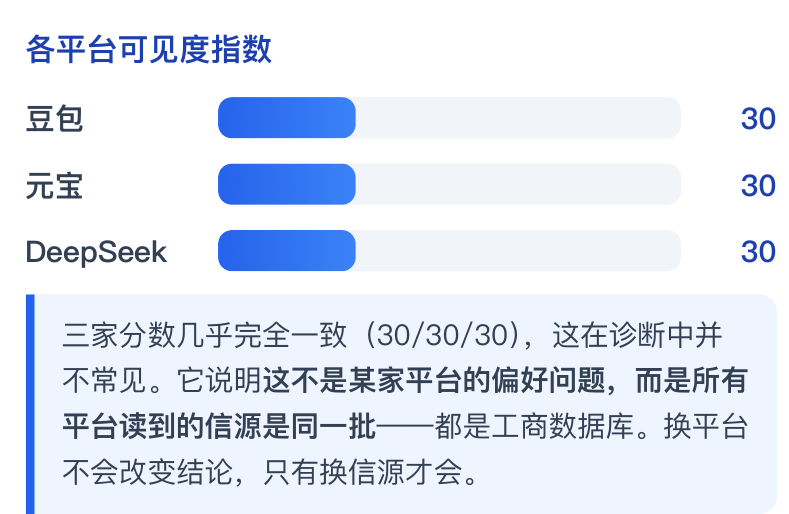
In AI responses to category-related queries, the source pool (i.e., the pages cited by the AI) consists primarily of business registration aggregation pages—because these pages consolidate information, albeit with limited detail. As a result: factual data about enterprises is verifiable, yet these facts do not appear in the AI’s “first-read position.”
When ZhiLian Matrix conducted a GEO diagnosis for Fujian Lüheyuan, the same distribution emerged: bid-winning records appear on procurement websites, cold-chain assets are mentioned in government feature reports, and licenses are listed on business registration pages—none of these three fact types appears on a single consolidated page. The six fields outlined in this article were specifically designed to address this gap. This snapshot reflects a single-client diagnosis and does not represent industry-wide averages.
III. Four-Step Process for Building an Enterprise Facts Page and Deploying Schema Markup
1. Build Onestatic facts page, aligning six key fields one by one. List bid-winning records in a table (project name, amount, year, procuring entity); specify cold-chain assets including cold-storage capacity, sorting-line configuration, and delivery radius; list license scope item by item. Allow AI crawlers to access the page, and render main content as static HTML.
2. Deploy Schema structured data. Cover at least three types: Organization, Service, and FAQPage. Schema markup is a standardized format that helps AI understand page content—these three types respectively help AI identify "which company this is," "what services are offered," and "what frequently asked questions exist." The value of centralized, structured presentation is empirically supported: GEO research from Princeton/Georgia Tech (Aggarwal et al., KDD 2024) shows that incorporating authoritative citations and verifiable statistics into content increases its visibility in generative engine responses by approximately 31%–41%.
3. Conduct multi-engine monitoring only after alignment. If field values themselves are inconsistent, retesting merely compares mismatched source documents—and cannot measure actual content-driven impact.
4. Use the facts page as the reference anchor point for all other content. At the end of each distributed version, include a link to the official fact page so that AI systems can cross-verify against an authoritative source.
IV. FAQ
Q1: Our county-level enterprise does not have an official website.enterpriseWhere should the fact page be hosted?
It can be placed on a WeChat Official Account’s fixed menu page, on the enterprise verification page of an industry-specific platform, or on a newly created standalone static webpage. The key requirements are that the page must be publicly accessible and its main content must be readable by web crawlers.
Q2: Can the bid award announcement be directly copied to theenterprisefacts page?
Only cite core fields (e.g., project name, amount, year, procuring entity); full-text copying is unnecessary. The purpose of the facts page is centralized presentation—not reposting announcements.
Q3:enterpriseHow frequently should the facts page be updated?
Bid award records are updated each time a new bid is awarded; licenses and cold-chain assets are verified quarterly; the company's full name and establishment date remain unchanged unless modified. Historical records are retained during updates, labeled with "As of [date]", and old records are not deleted.
Scope clarification: This article reflects only the current visibility status of the featured companies on AI search engines within GEO scenarios and does not represent their actual operational capabilities. Real service capacity and operational performance often lag behind online presence, and AI systems may not yet capture them—precisely why businesses need to proactively implement GEO optimization.