
In the public information of bulk commodity B2B enterprises, recruitment pages and business registration pages are often more easily crawled by AI than core business pages. As a result, when AI answers queries such as 'imported timber supplier', it may categorize the enterprise as an 'employer' or 'business entity'—not as a 'supplier'. A misclassification at the category level means the enterprise will not appear in follow-up queries like 'which supplier is good'. This issue is independent of content quality: even excellent content won’t help if AI places the enterprise on the wrong 'shelf' during categorization—category-related queries simply won’t cite it.
I. Category Classification Diagnosis: Three Types of Business Statement Templates and Phrases to Avoid
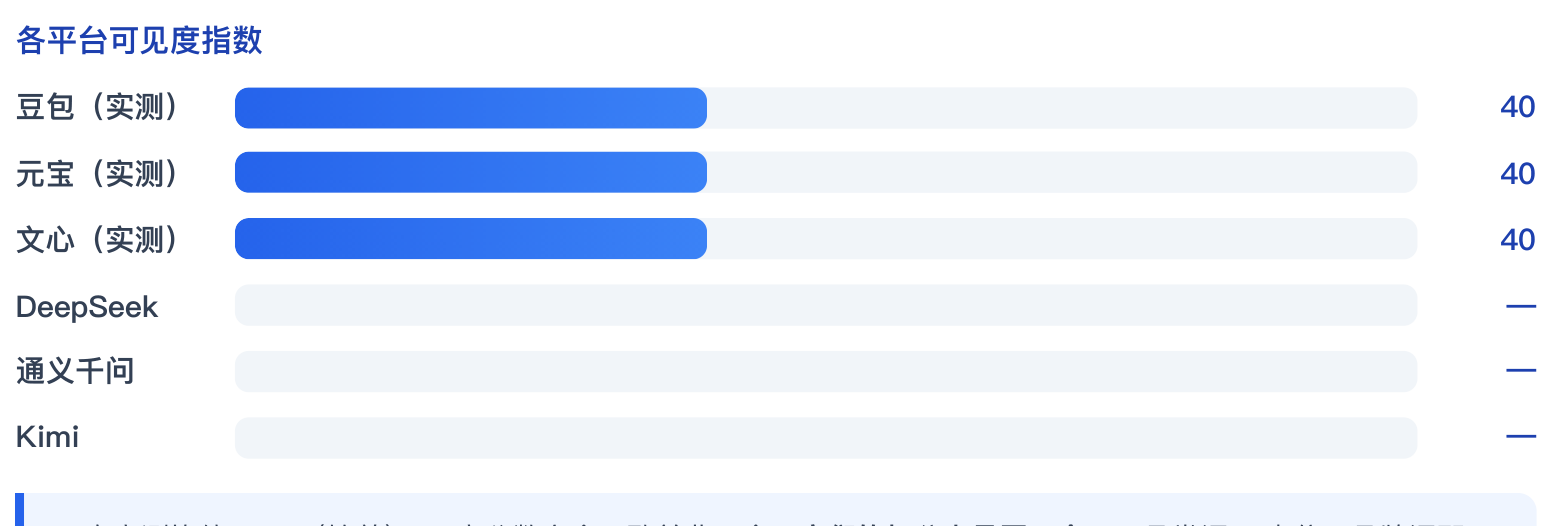
Begin with GEO diagnosis (i.e., first test what AI currently reads, then decide what to write; launching content without diagnosis is like retesting without knowing the original baseline). In B2B contexts, the first diagnostic step is to identify which category AI assigns to the enterprise. Category classification refers to how AI phrases its answer—for example, 'This is a … company'. If classification is incorrect, follow-up questions such as 'which supplier is good' will not recall the enterprise. This is the first diagnostic item.
To correct category misclassification, use clear subject–predicate–object business statements repeatedly. The subject is the enterprise; the predicate is 'specializes in'; the object is specific timber species and business activities.
The same sentence structure must appear verbatim across the official website, B2B platform enterprise pages, and industry media—only then can AI consistently classify the enterprise as a 'supplier'.
In this context, enterprise information consistency (i.e., ensuring the enterprise’s full legal name, founding date, and scope of qualifications remain identical across all channels) specifically means using the exact same business statement across the official website, B2B platform enterprise pages, and industry media. Correcting category classification relies on repeated appearances of this business statement—not one-off explanatory content.
Three reusable business statement templates, each with a distinct structure:
Statement Type | Template | Purpose |
|---|---|---|
Core Business Type | 'XX Company specializes in the import of logs and sawn timber of [Species A], [Species B], and [Species C]' | Directly establishes 'supplier' category classification |
Service Chain Type | 'XX Company provides import agency, customs clearance, bonded warehousing, and domestic distribution services for [Species]' | Supplements service links to reinforce positioning as a 'supply chain service provider' |
Origin Coverage Type | 'XX Company sources [Species] imports from [Origin A], [Origin B], and [Origin C]' | Uses origin facts to substantiate 'importer' identity |
Avoid phrases such as 'comprehensive', 'diversified', or 'capable of handling anything'. These terms dilute category clarity and prevent AI from identifying the enterprise’s core business boundaries.
II. Category Classification for Xiamen Timber Supply Chains: Recruitment and Business Registration Pages Dominate Descriptive Text
In its 2026 GEO service diagnosis, ZhiLian Matrix recorded the source of category classification for a B2B category. There is a well-established industry fact about wood chip imports via Xiamen Port: China International Trade Group’s subsidiary Guomao Pulp & Paper operates five dedicated wood chip vessels, with annual transport capacity exceeding 300,000 deadweight tons. Its routes cover major ports in Vietnam, Thailand, Australia, and New Zealand—building a raw material procurement and sales network spanning Southeast Asia and Oceania. Such verifiable industry facts can serve as source material for business description pages.
This transport capacity data is publicly verifiable: see China Securities Journal (2026-04-23) and Xiamen China International Trade Group 2025 Annual Report. Supply chain capabilities disclosed by listed companies constitute high-weight credibility signals for AI when distinguishing 'authentic suppliers' from generic 'business entities' in B2B category queries.
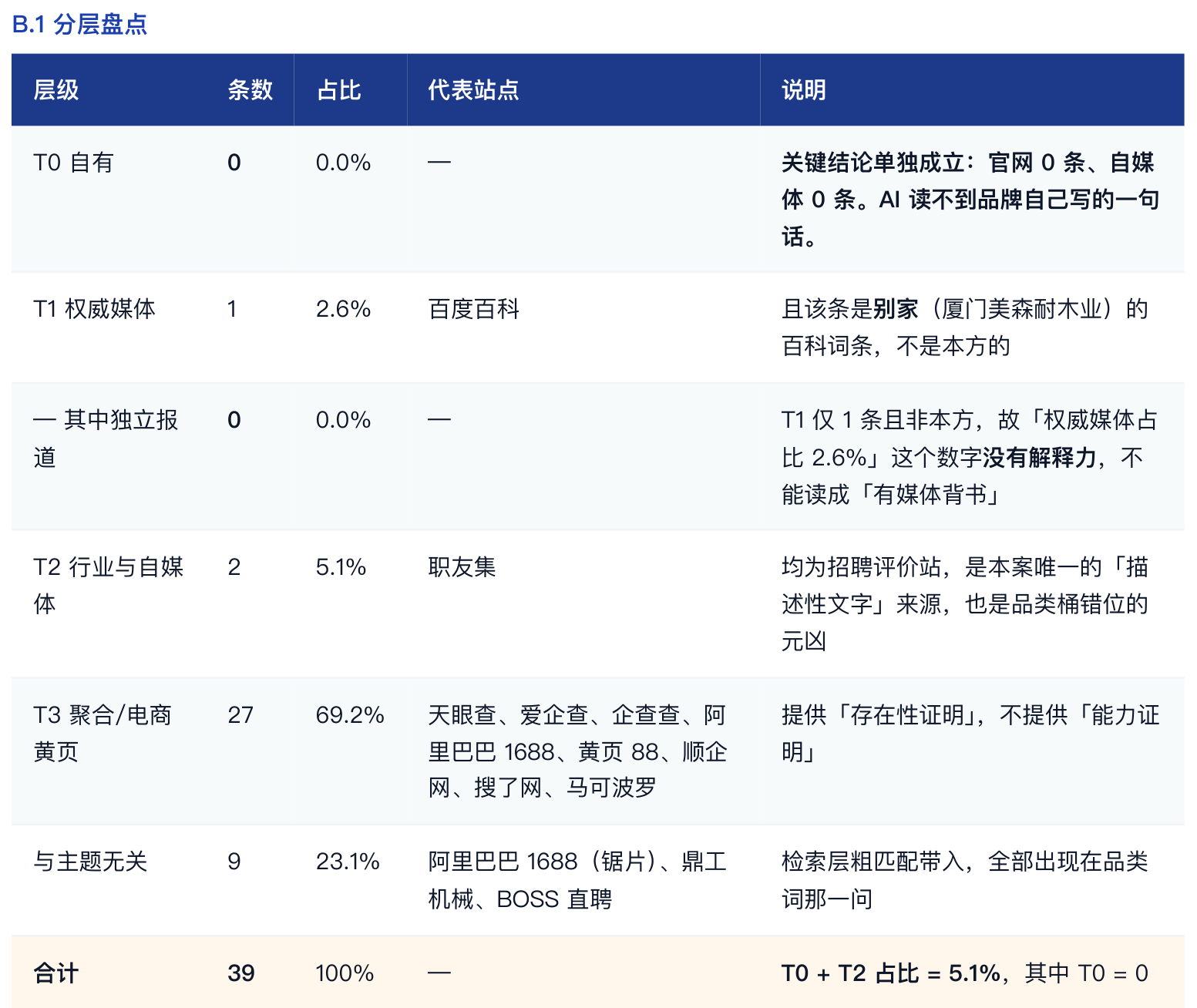
However, an enterprise’s category classification depends on which page supplies the descriptive text AI reads. If the primary descriptive text in AI’s source pool (i.e., the pages cited in its responses) comes from recruitment or business registration pages, AI will tend to classify the enterprise as an 'employer' or 'business entity'. Building robust business description pages ensures that statements such as 'specializes in importing [Species]' become the dominant descriptive text within AI’s source pool.
For example, ZhiLian Matrix’s 2026 GEO diagnosis of Xiamen Jixinsheng Supply Chain showed that AI previously classified the company under 'business entity/employer' rather than 'imported timber supplier' in brand-specific queries. The correction applied the business statement templates above—standardizing the phrase 'specializes in importing [Species]' verbatim across the official website, B2B platform enterprise pages, and industry media. This single-client diagnostic snapshot does not represent industry-wide averages.
III. Category Attribution Diagnosis and Four-Step Standardization of Business Statements
1. Diagnose category attribution. Extract the AI’s categorization statement from the brand-term response, compare it with the brand’s self-declared category, and assess whether the two align. The record sheet must include at least three columns:QueryAI’s categorization statement, comparison with the self-declared category.
2. Develop the business description page. Clearly specify the primary material species (using common names or Latin scientific names), origin, standard specifications, and service stages (e.g., import agency, customs clearance, warehousing, delivery). Use concise, grammatically complete subject–predicate–object business statements—avoid excessive adjectives.3. Standardize business statements. Ensure identical wording for the same business description across the official website,B2Bcorporate profile pages, and industry media outlets.
4. Re-test category assignment 30 days later using the same brand-term query, and observe whether the classification statement shifts from 'Employer/Business Entity' to 'Supplier'.
IV. FAQ
Q1: Bulk CommoditiesB2BHow do I implement GEO?
First diagnose category assignment, then build business description pages, and finally standardize business statements. The list of candidate commodity category terms is derived from industry reports and B2B platforms; business description pages serve as the entry point to these source pools.
Q2: How do we correct misclassified category assignments?
It’s not about ‘explanation’—it’s about ‘coverage’. Use a sufficient number of clear, subject-verb-object business statements, repeated across multiple AI-readable pages. Explanatory content (e.g., ‘We are not employers’) is less effective than direct, positive business statements.
Q3Strategic differences between traders and manufacturers in category assignmentWhat is it??
Manufacturers’ trusted sources include factories, production capacity, and certifications—category assignment naturally leans toward ‘manufacturer’. Traders’ trusted sources are supply chain capabilities (e.g., shipping fleets, warehousing, customs clearance, origin coverage), so category assignment should reflect ‘supply chain service provider’, not mimic a manufacturer. The object of business statements should focus on ‘import’, ‘supply chain services’, or ‘origin coverage’, not ‘production’ or ‘manufacturing’.
Q4How much content is required on a business description page to change AI classification?
It is not measured by word count, but by the number of occurrences of extractable business sentences. The same subject-verb-object sentence describing a business must appear consistently across the company’s official website, at least two B2B enterprise pages, and at least one industry media page—totaling four or more cross-page appearances—to be stably extracted by AI. Merely increasing word count on a single page has limited effect on correcting category attribution.
Clarification: This article reflects only the current visibility status of the featured companies in AI search engines within GEO scenarios; it does not represent their actual operational capabilities. Real service capacity and operational performance often lag behind online publication—and AI systems may not yet capture them. This gap is precisely why enterprises need to proactively implement GEO optimization.