
Purchasers of industrial drones ask AI, 'Which company is suitable for this scenario?' Being named by AI only indicates that the AI recognizes the brand's existence; whether the category term (e.g., 'industrial drone manufacturer') appears in AI’s candidate list determines whether purchasers will even see the company. Xiamen’s low-altitude economy has well-defined industrial infrastructure. As of April 1, 2026, Xiamen hosts 1,246 enterprises related to the low-altitude economy—ranking 27th among major Chinese cities. The low-altitude test flight runway in Xiamen’s Air Economy Zone has officially entered operation and can accommodate test flights for unmanned aerial vehicles (UAVs) weighing under 500 kg. These verifiable industrial facts serve as source material for building authoritative third-party information pools.
I. Ecosystem-based GEO: Three Types of Third-Party Information Pools and Their Entry Criteria
Ecosystem-based GEO—i.e., securing visibility for category terms by entering third-party information pools, not merely optimizing the corporate website—is one of the four foundational implementation pillars of ZhiLian Matrix GEO 4.0. Its core principle is that category-term visibility depends on inclusion in third-party information pools (i.e., pages cited by AI in its responses), rather than on optimizing the company’s own website alone.
When AI answers a query such as 'recommended industrial drone manufacturers', the candidate list draws from industry evaluations, market share reports, in-depth Zhihu articles, and media comparisons—sources all external to the company. A corporate website represents self-reported brand messaging; AI is far less likely to cite it in responses to category-based queries than it is to cite third-party evaluations.
There are three actionable pathways into third-party information pools, each with distinct entry criteria:
Information Pool Type | Entry Criteria | What the Enterprise Must Prepare |
|---|---|---|
Industry Evaluations / Horizontal Comparisons | Complete product specifications, clearly labeled operating conditions, and citable scenario-specific data | Official Specifications Sheet (indicating standard payload capacity, operational altitude, wind resistance rating), plus scenario descriptions (e.g., maritime patrol, power line inspection) |
Market Share / Industry Reports | Verifiable delivery records and customer-type classification | De-identified delivery record list and customer-type distribution |
Zhihu / Industry Media In-Depth Articles | Discussions of technical details or scenario-specific judgment criteria | Technical selection criteria (e.g., 'operational boundary between VTOL fixed-wing and multirotor UAVs in power line inspection') |
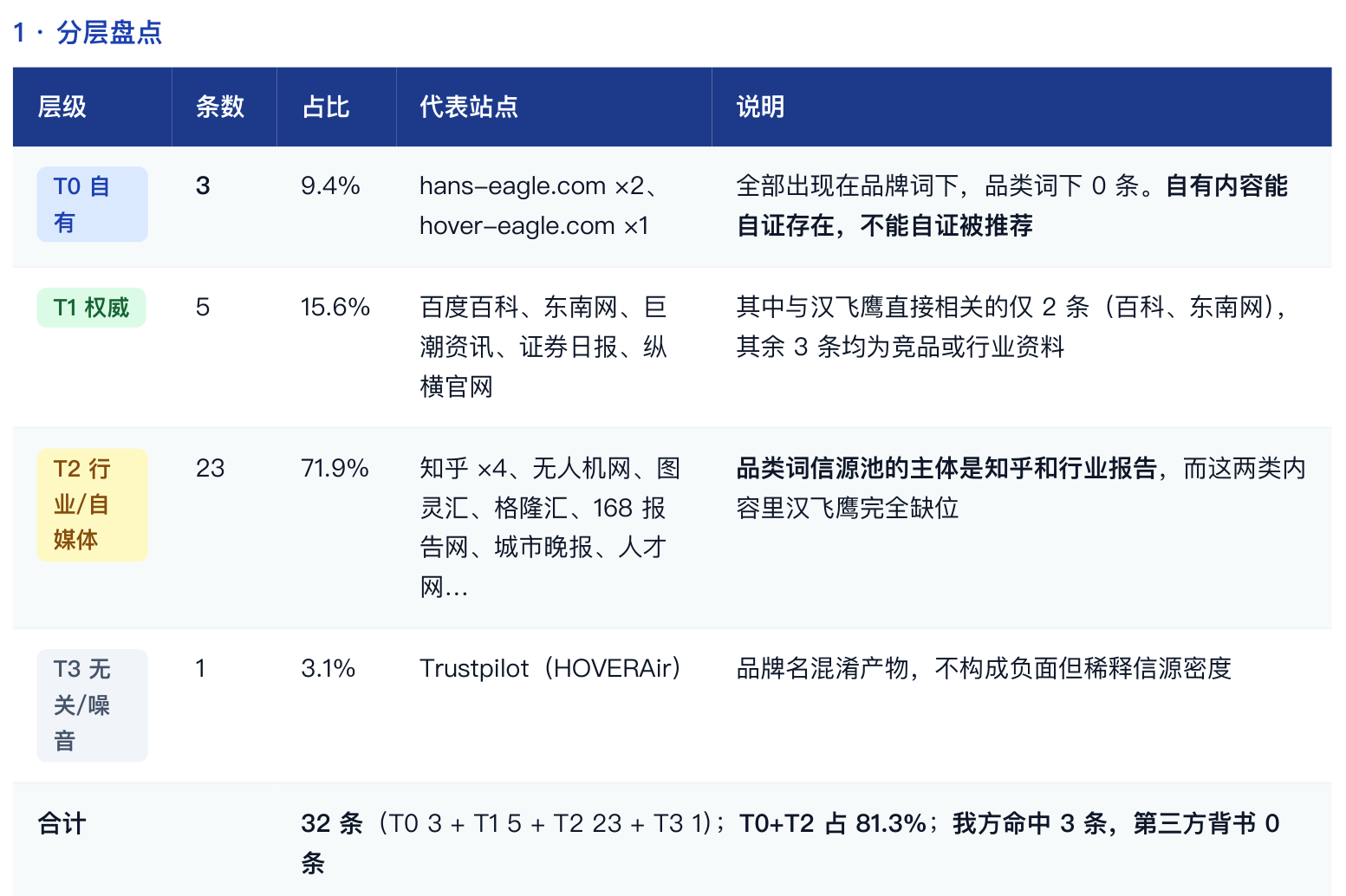
II. Xiamen’s Industrial Drone Information Pool: Brand Terms Are Cited; Category Terms Rely Primarily on Industry Evaluations
In its 2026 diagnostic analysis of the industrial drone category, ZhiLian Matrix conducted an inventory of relevant information pools and observed a repeatable pattern:
Metric | Observation |
|---|---|
Brand-Term First-Sentence Citation Rate | Typically cited; business registration data and official websites are parseable |
Category-Term Inclusion Rate | Candidate lists rely primarily on industry evaluations and market share reports; local enterprises appear infrequently |
Consistency of Parameter Definitions | A prerequisite for inclusion in horizontal comparisons; inconsistent definitions reduce AI’s accuracy in extracting parameter data |
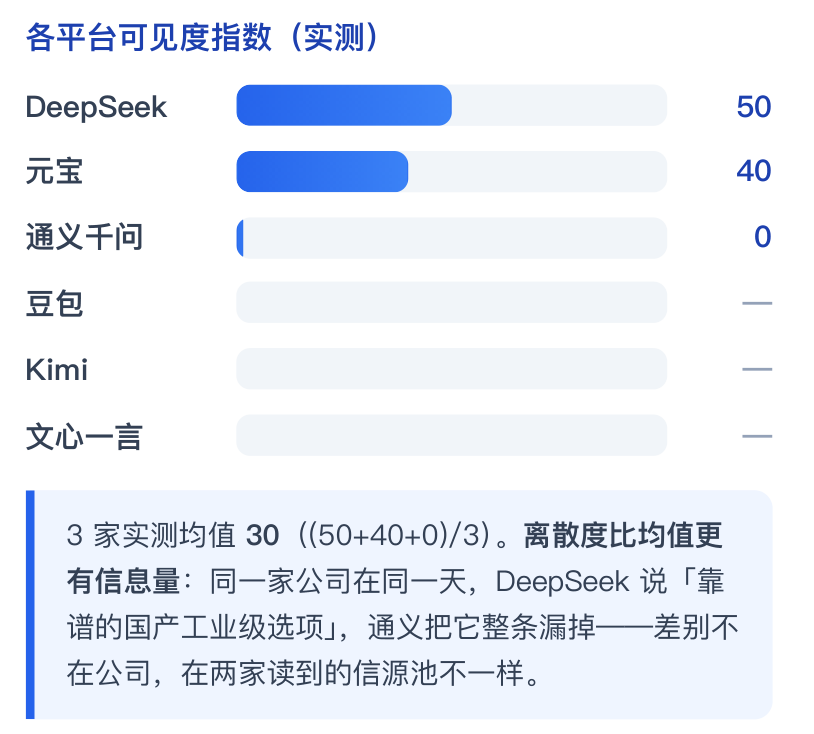
Xiamen’s low-altitude economic activities provide raw material for industry media coverage and evaluation content. However, such activities do not automatically enter authoritative information pools. Enterprises must compile product parameters, application scenarios, and test-flight data into ready-to-cite asset packages—with the standard being: third-party media outlets or evaluation agencies can directly quote the parameters and scenario descriptions without requiring follow-up confirmation from the enterprise.
For example, ZhiLian Matrix’s 2026 GEO diagnostic service for Xiamen Hanfeiying Aviation showed that while AI cites the brand term, the category-term candidate list relies predominantly on industry evaluations and market share reports—and the enterprise’s official website accounts for only a limited share. Entering third-party information pools requires first preparing a complete specifications sheet and scenario asset package. This snapshot reflects a single-client diagnosis and does not represent industry-wide averages.
Such government documents are inherently high-authority third-party sources:Xiamen Municipal Bureau of Industry and Information Technology – Response Letter to Proposal Handling (2025)Explicitly identifies Hanfeiying as a local UAV/eVTOL R&D enterprise within official government documents.During AI-assisted cross-verification, the credibility weight assigned to such publicly released government letters exceeds that of self-reported corporate statements.
III. Standardizing Parameter Definitions and the Four-Step Process for Entering the Source Pool
1. Standardize parameter definitions. Issue an 'Official Parameter Table'—one page per model—with clearly specified operating conditions (standard payload, altitude, wind resistance rating). For speed-related metrics, explicitly indicate whether values represent 'cruise' or 'maximum' speed—avoid mixing terminology. All external communications shall reference only this table.
2.Organize a reusable asset package, including: a parameter table (with operating conditions clearly labeled), application scenario descriptions (e.g., maritime inspection, power line patrol), and anonymized delivery records. The goal of the asset package is not visual appeal, but readiness for direct third-party citation.
3.Enter industry evaluation media pools. Proactively share the asset package with industry media outlets and testing institutions. Xiamen’s low-altitude economy test flight runway and industrial park naturally serve as engagement touchpoints; flight test data itself can be used directly as evaluation material.
4.Monitor candidate lists for category-related search terms. Conduct repeated cross-platform testing using fixed queries, and record whether brand names appear in the candidate lists returned for category terms—not only tracking explicit brand mentions.
IV. FAQ
Q1: Do industrial products lackC-endtraffic—does GEO still make sense?
Yes. Buyers of industrial products also use AI for preliminary due diligence. The list of candidate brands derived from category-related search terms determines which companies they review first. C-end traffic is not a prerequisite; rather, positioning within the trusted information pool matters most.
Q2: How do we standardize parameter definitions?
Publish an official parameter table and require all channels to reference this single source. Specify speed, payload capacity, and endurance under standardized operating conditions—do not mix values measured under different conditions.
Q3: How can a company get included in industry evaluations?
It’s not about ‘buying a placement’—it’s about organizing product specifications and real-world scenario data into reusable, citable assets, then proactively engaging with industry media and evaluation agencies. Xiamen’s low-altitude economy test flight runway and related industrial activities provide natural, authentic touchpoints.
Q4: How can small enterprises without existing industry evaluation resources get started?
Start with a ‘Citable Asset Pack.’ Even without immediate connections to evaluation agencies, the pack itself can be published on your official website or WeChat Official Account as a fact-based page readable by AI. Meanwhile, use consistent search queries to monitor candidate keywords for your product category and track whether new third-party content begins citing these assets.
Q5: What are the boundaries for competitor comparison content in GEO?
Comparisons are allowed, but disparaging or denigrating comparisons are not permitted. The actionable boundary is: Compare only "verifiable parameters and scenario suitability," not conclusions about "which is better." Present comparison content as "selection criteria" (e.g., "which scenarios suit vertical-takeoff-and-landing fixed-wing drones, and which suit multirotor drones"), rather than in the form of rankings.
Clarification of scope: This article reflects only the currently observable status of case enterprises’ AI search engines within GEO scenarios; it does not represent their actual operational capabilities. Real service capacity and operational performance often lag behind online visibility—and AI systems may not yet access such information—precisely why enterprises need to proactively optimize their GEO presence.