
Core Summary:
An increasing number of brands are receiving GEO diagnostic reports—but what do metrics like the AIVO score, the four-dimensional radar chart, and the L1–L4 cognitive distribution actually mean? This article clarifies these concepts using three implementation cases from ZhiLian Matrix: Guiyang JiuJiu International Home Furnishings, Xiamen Jixinsheng Supply Chain, and Xiamen Hanfeiying Aviation. It explains how to interpret the overall AIVO score, what each of the four dimensions represents, and how the L1–L4 cognitive layers map to concrete next steps—so brands can confidently act after reviewing their report.
I. Why a GEO Diagnostic Report Cannot Be Understood by Its Overall Score Alone
Many brands instinctively check only the overall score upon receiving a GEO diagnostic report: “What’s my score? Is it passing?” However, relying solely on the overall score risks misdiagnosis: two brands both scoring in the low 40s may face entirely different root causes—one may be visible to AI but suffer from poor content infrastructure; the other may have solid content but struggle with intense competition pushing it down in AI responses. Their respective next steps would therefore differ significantly.
According to the China Internet Network Information Center (CNNIC)’s "Report on the Development of Generative AI Applications (2026)", as of the first half of 2026, China’s generative AI user base exceeded 700 million, with a penetration rate surpassing 50%. How AI describes a brand is no longer a niche concern. A qualified GEO diagnostic report must answer at least four questions: (1) Can AI see your brand? (AI Visibility); (2) Can AI correctly parse your official website and authoritative sources? (Content Infrastructure); (3) How densely are competing brands occupying AI-generated answers? (Competitive Landscape); and (4) Is AI’s description of your brand accurate—and free of negative sentiment? (Reputation Health). These four dimensions constitute the AIVO Four-Dimensional Model. The overall score is a weighted composite—but actionable insights come from identifying gaps within each dimension.
II. What Each AIVO Dimension Measures
III. Three Cases, Three Distinct Gaps
Case 1: Guiyang JiuJiu International Home Furnishings — Moderate visibility, near-zero content infrastructure
Guiyang JiuJiu International Home Furnishings has specialized in high-end custom woodwork in Guiyang for 32 years, with an overall AIVO score of ~43. Breaking it down: its AI Visibility score is relatively high (~73), indicating AI recognizes the company’s existence—but its Content Infrastructure score is only 20. Decades of offline expertise have not been translated into structured, online authoritative sources; its official website and public content are virtually nonexistent. In this case, the immediate priority isn’t mass content publishing—it’s building a foundational “fact base”: structuring verifiable assets such as “32 years in operation,” “7,000 sqm showroom,” and “5,000+ satisfied clients.” Without this baseline, even abundant new content won’t earn AI citations.
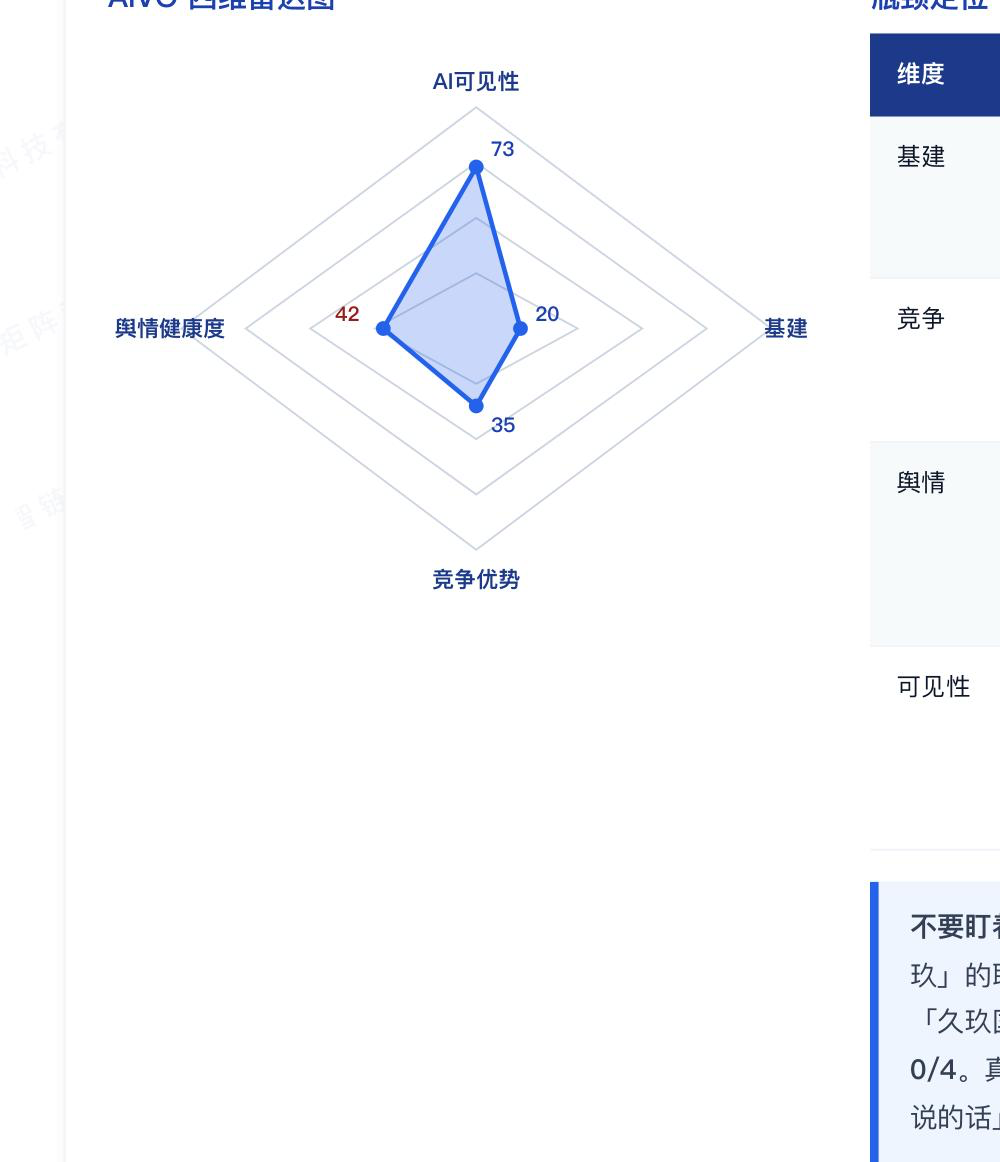
Figure: GEO Diagnostic AIVO Four-Dimensional Radar Chart for Guiyang JiuJiu International Home Furnishings (Overall: 43/100; single-client diagnostic snapshot)
Case 2: Xiamen Jixinsheng Supply Chain — Solid infrastructure, but unstructured by decision-maker role
Jixinsheng specializes in import customs clearance for timber and stone—a pure B2B enterprise. Its challenge isn’t poor website quality, but rather content that fails to align with the three-tier procurement decision journey: (1) executive-level trust building, (2) procurement-team due diligence, and (3) customs officer operational clarity. As a result, AI cannot surface relevant answers when executives ask “Is this supplier reliable?” nor when customs officers ask “What are the exact procedural steps?” For such brands, the next step is rebuilding the keyword matrix—mapping content to four lexical categories (core, long-tail, scenario-based, question-based) and scheduling publication according to relevance windows.
Case 3: Xiamen Hanfeiying Aviation — Brand terms trigger results, but category terms yield zero matches
Taking Xiamen Hanfeiying Aviation as an example, its AIVO score stands at ~49, with a relatively high Reputation Health score (~74), indicating AI descriptions of the brand are generally accurate. However, when examining AI visibility in detail, a typical pattern emerges: when users directly ask for the brand name, AI mentions it in the first sentence across all five test questions; yet when the query shifts to a category-based question—such as 'recommended manufacturers of industrial-grade VTOL fixed-wing drones'—the brand does not appear in the response at all. This reflects a common disconnect between brand terms and category terms among B2B manufacturing companies. The next step is to enrich content around category terms and comparative terms—not further reinforce brand terms.
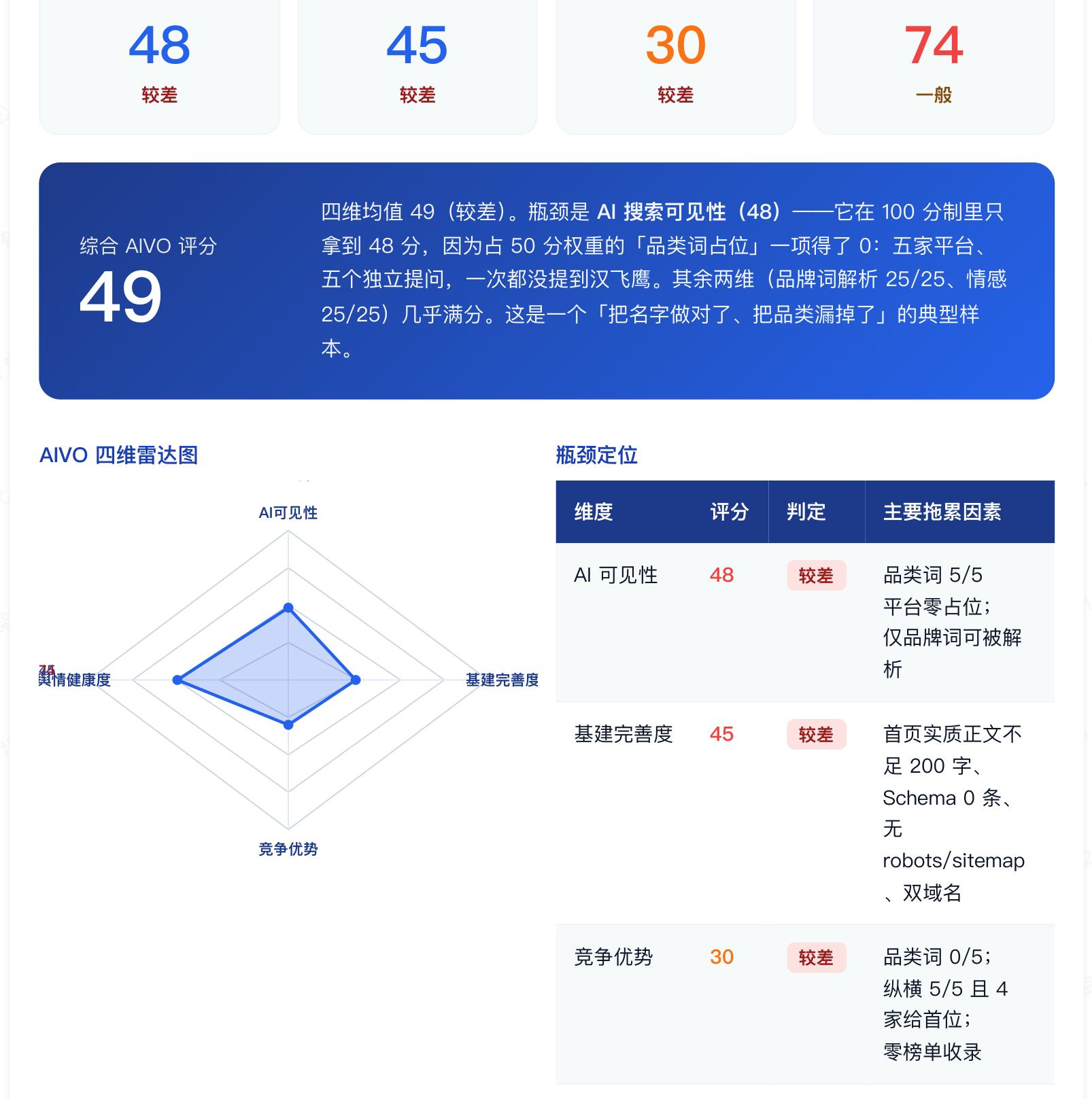
Figure: Xiamen Hanfeiying Aviation GEO Diagnostic Report — AIVO Four-Dimensional Overview (Composite Score: 49/100; Snapshot for a Single Client)
IV. User Cognitive Layers L1–L4: Beyond the Score — Understanding How Deeply the Brand Is 'Understood'
L1–L4 represent four progressive stages of brand awareness, corresponding to GEO optimization priorities: L1 Awareness ('Has the user heard of this brand?'), L2 Trust ('Is it reliable?', heavily influenced by negative reviews), L3 Depth (in-depth understanding of product pricing, specifications, or product lines), and L4 Conversion ('Where to buy and how to place an order'). Higher weightings indicate greater reliance on content targeting that specific cognitive stage; the diagnostic analysis uses these weights to allocate keyword focus and advertising priorities.
AIVO scores tell you 'how well you’re doing'; the L1–L4 cognitive layering tells you 'how deeply AI understands your brand'. These are two complementary perspectives:
L1 Awareness: Does AI recognize the brand’s existence and know its name? This corresponds to 'basic entity recognition'—if AI doesn’t know you exist, it can’t surface you.
L2 Trust: Once AI knows who you are, can it verify your credibility—and is there third-party evidence supporting that?
L3 Depth: Can AI compare your service details, delivery capabilities, and differentiation versus competitors?
L4 Conversion: Can AI direct users to your official website and help them locate entry points for quotations and inquiries?
Jiujiu’s diagnostic distribution is roughly: L1 (30%), L2 (40%), L3 (22%), and L4 (8%)—indicating that both users and AI search engines recognize the brand only at the level of 'knowing who they are and what they do', but have not yet reached the stage of 'recommending them within specific use cases'. This explains why Jiujiu’s AI visibility score is relatively high, yet local users asking 'Who offers high-end custom woodwork in Guiyang?' still don’t see it: awareness hasn’t advanced to L3.
V. Next Steps After Receiving Your GEO Diagnostic Report
The actions taken across the three case studies are consolidated into a priority table:
In Hehui’s GEO system, the 'Smart Chain Matrix' formalizes this diagnostic workflow:
First, conduct multi-engine testing to obtain the AIVO four-dimensional scores; second, analyze the L1–L4 cognitive distribution; finally, generate a content scheduling plan and technical enhancement checklist based on identified gaps. Note that AIVO thresholds and industry benchmarks shift with competitive intensity. Scores in the report reflect a point-in-time snapshot; we recommend retesting every 1–2 months to assess whether content initiatives are genuinely moving the needle.
VI. Frequently Asked Questions
1. What AIVO score qualifies as 'passing'?
There is no universal passing threshold. In industries with low competition density, a score of 40 may place you among the top performers; in highly competitive sectors, a score of 60 may still rank mid-to-lower tier. The correct approach is horizontal benchmarking against peers in the same industry and region—and vertical tracking via monthly retests—not relying on any single absolute number.
2. Do scores in the diagnostic report change over time?
Yes. AIVO is a point-in-time snapshot, dependent on which sources AI engines reference on that day, the specific query terms used, and whether real-time web access is enabled. Professional diagnostics ensure consistency by retesting using the same set of query terms, the same group of AI engines, and the same time window—so only genuine impact from content actions can be measured.
3. Why does my brand appear for brand-name queries but not for category-based queries?
This is the most common phenomenon among B2B brands. If your brand name is recognized, it means the AI knows you; if category-related terms don’t return your business, it indicates the AI hasn’t yet learned to recommend you for such queries. At this stage, adding more brand-focused content yields diminishing returns. Instead, prioritize creating content around category terms, comparison terms, and scenario-based questions—so the AI includes you during users’ ‘supplier search’ phase.
4. What is the relationship between GEO and matrix operations?
Content produced through matrix operations—especially scenario-driven content—serves directly as a GEO data source. Both GEO and matrix operations draw from the same enterprise knowledge base of verified facts, serving AI engines and real users respectively, with both ultimately driving trackable commercial conversions. Content gaps identified during the GEO diagnostic phase often align precisely with scalable content themes for matrix operations.
5. How soon after a GEO diagnosis will score changes appear?
Fact-based content (e.g., company profiles, official website optimizations) typically shows improvements in brand-term recognition accuracy within 1–2 weeks; category and scenario-term visibility usually requires 2–3 months of consistent content accumulation; highly competitive industries may need 3–6 months. The diagnosis marks the starting point—not the endpoint.
6. What is the typical cost of GEO services?
Industry reference range: Basic single-engine coverage generally costs tens of thousands of RMB per year; full-engine coverage—including international markets and localized sub-sites—typically ranges from one hundred thousand to several hundred thousand RMB per year. Exact pricing depends on industry competitiveness, number of target keywords, requirements for multilingual support overseas, and technical website enhancements. ZhiLian Matrix provides customized quotations based on actual needs identified post-diagnosis—no fixed-price packages are offered.
This article’s AIVO model and case data originate from ZhiLian Matrix’s diagnostic methodology and client service practice. It is intended for methodological discussion only and does not constitute performance guarantees.