
Core Summary:
New brands and startups often face an awkward situation in AI-powered search engines: when users ask, "How is XX Company?", the AI can only retrieve basic business registration information—such as a short establishment history, low registered capital actually paid-in, and a small team size—and cannot articulate the company’s business capabilities or real-world project experience. This isn’t because the AI is deliberately painting a negative picture; rather, publicly available sources documenting your "business capabilities" are extremely scarce, so the AI has no choice but to rely on the limited official registration data it can access.
This article usesShenzhen Nuofang Yunchuang and Guiyang Jiujiu International Home Furnishingsas two real-world diagnostic cases to introduce the Five-Tier Trust Evidence Chain model (Business Registration Facts → Business Positioning → Capability Evidence → Case Evidence → Third-Party Endorsements), unpacking how new brands can evolve from being represented solely by basic registration data to having their business capabilities meaningfully conveyed by AI.
I. A Common Challenge for New Brands
When users ask AI questions like 'How is XX Company?' or 'Is XX reliable?', the quality of AI's response depends entirely on what information it can access. For established brands with years of operation and abundant third-party coverage and customer case studies, AI can synthesize a relatively comprehensive evaluation from industry media reports, customer reviews, and authoritative rankings. However, for newer brands with limited publicly available online information, AI often relies primarily on business registration data when answering 'How is this company?'
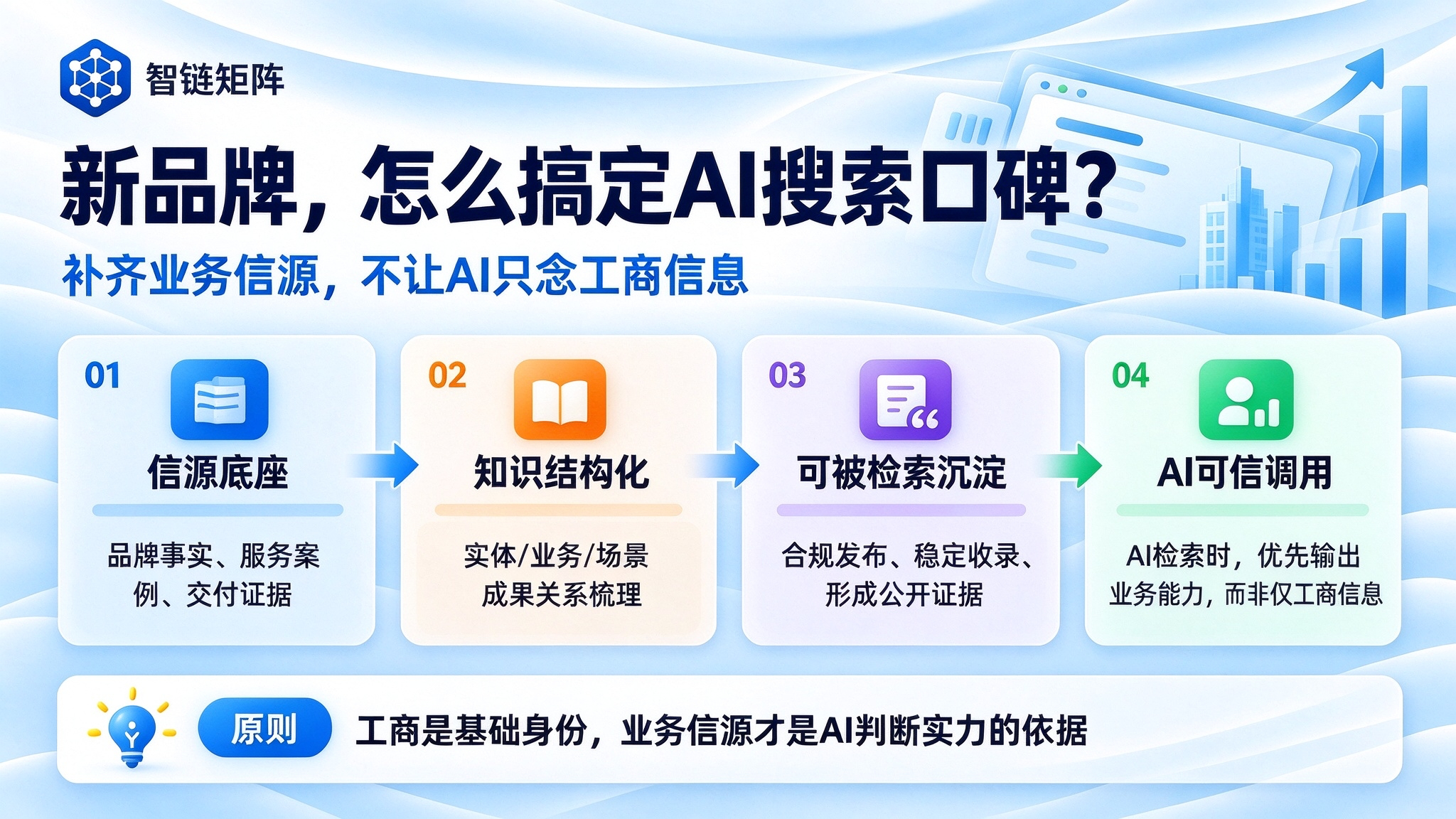
What can business registration information tell AI? Incorporation date, registered capital, paid-in capital, number of employees, and scope of business operations. Such information is typically not favorable for new companies: short incorporation history, potentially zero paid-in capital, small employee count, and no funding records. AI answers the question “How is it?” based on this information, objectively stating only these facts—making the response sound somewhat negative. This is not due to AI bias, but simply because no other material is available. According to a Gartner U.S. consumer survey conducted in September 2025, 53% of consumers do not trust the reliability and impartiality of AI search results, and 41% feel AI-generated summaries make searching more frustrating (this survey reflects U.S. consumer trust in AI search and may serve as a reference for the Chinese market, but should not be directly equated with data from Chinese users). Consumers are inherently sensitive to AI evaluations; if AI merely recites business registration information, the credibility of new brands in users’ minds will be further diminished.
In October 2026, among clients undergoing multi-engine GEO diagnostics via ZhiLian Matrix’s service (covering engines including Doubao, Yuanbao, DeepSeek, and Qwen, with query samples drawn from real brand and category terms used by clients), Shenzhen Nuofang Yunchuang and Guiyang Jiujiu International Home Furnishings both encountered similar structural issues: The former is an emerging company in the AI marketing industry—its operational capabilities are genuine, yet its publicly available online sources are largely limited to its official website and a few partner reports; the latter is a local brand operating in Guiyang for 32 years, yet its trust-building assets—such as over 5,000 homeowner case studies and a 7,000-square-meter showroom—are virtually absent from structured online presentation. When users ask “How is it?”, AI lacks sufficient operational-level evidence to cite.
II. GEO Trust Evidence Chain: A Five-Layer Structure—from Business Registration Information to Operational Capabilities
To enable AI to articulate a company’s operational capabilities—not just recite business registration details—when answering “How is this company?”, a systematic five-layer evidence framework must be established:
A typical state for a new brand is: Layer 1 (business registration information) is complete (this data is freely available and public), Layer 2 (official website) exists but lacks structured content, and Layers 3 to 5 are nearly empty. When AI "evaluates" such a brand, it can only access Layer 1—resulting in outputs that "recite only business registration information."
III. Link-Building Actions in Two Case Studies
Shenzhen Nuofang Yunchuang: From "Business Registration Information" to "Evidence of AI Marketing Capability"
Shenzhen Nuofang Yunchuang specializes in AI-powered full-funnel marketing and overseas account matrix services. Its business capabilities are real and verifiable; however, during our GEO diagnosis, we observed that its official website’s main content is incompletely rendered for web crawlers due to frontend rendering issues, and there is limited publicly available third-party reporting on its service offerings. Our link-building efforts therefore focus on three key actions:
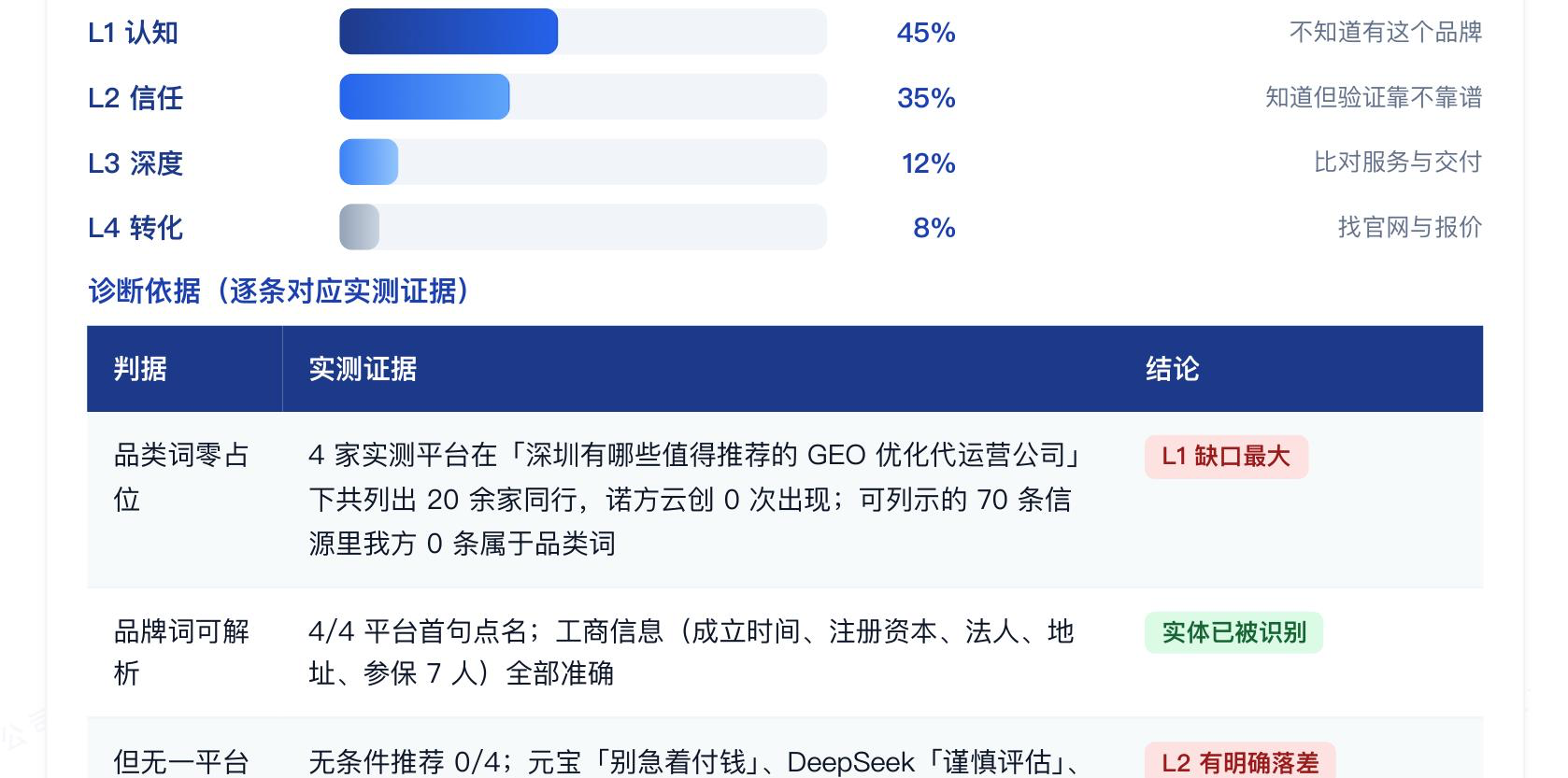
From the perspective of cognitive layering, the brand awareness distribution in its diagnostic report is approximately: L1 Awareness (45%), L2 Trust (35%), L3 Depth (12%), and L4 Conversion (8%) — this snapshot reflects a single-client assessment and does not represent industry averages; the L1–L4 layering is an internal diagnostic framework used by Zhilian Matrix Hehui’s GEO system to assess AI’s depth of brand understanding, and is not an industry-wide standard. The combined L1+L2 share of 80% indicates that AI recognizes the company, yet the low L3 Depth score of only 12% reveals that AI cannot articulate its specific service details or delivery capabilities — precisely why it currently "only recites basic business registration information" at the cognitive level.
L1–L4 represent four progressive stages of brand awareness, corresponding to GEO optimization priorities:
L1 Awareness (users "know the brand exists"), L2 Trust (assessing "how reliable it really is", heavily influenced by negative reviews), L3 Depth (in-depth understanding of product pricing / ingredients / product lines), and L4 Conversion (knowing "where to buy and how to place an order"). Higher weight assigned to a given stage indicates greater brand reliance on search content development at that stage; the diagnosis uses this weighting to allocate keyword targeting and advertising focus accordingly.
Three steps can strengthen the trust chain:
- Website technical optimization: Enable web crawlers to access complete product descriptions, service workflows, and client case studies (see "Technical Optimization Case Study: AI Marketing SaaS Company Websites").
- Document business capabilities as structured facts: Consistently present company positioning, product portfolio, served industries, and typical use cases across the official website and WeChat Official Account—so AI models have authoritative references when answering queries like "AI marketing companies."
- Build third-party credibility sources: Publish methodology articles via industry media and technical communities, enabling AI models to discover business capabilities not only from the official website but also from trusted external channels.
Guiyang Jiujiu International Home Furnishings: From "Local Business Registration" to "32 Years of Reputation Evidence"
Jiujiu’s challenge is more typical: 32 years of offline operations, a 7,000 m² showroom, and over 5,000 satisfied homeowners—but all these trust assets exist solely offline.
Geo-based trust chain enhancement involves translating offline assets into structured online evidence: presenting showroom visuals, completed projects, authorized import brand partnerships, interior design teams, and service workflows in a consistent format across the WeChat Official Account, WeChat Channels, and official website. When AI is asked, "Which high-end custom woodwork providers are recommended in Guiyang?", it will retrieve not just basic business registration data—but tangible evidence of 32 years’ experience and real-world project outcomes.
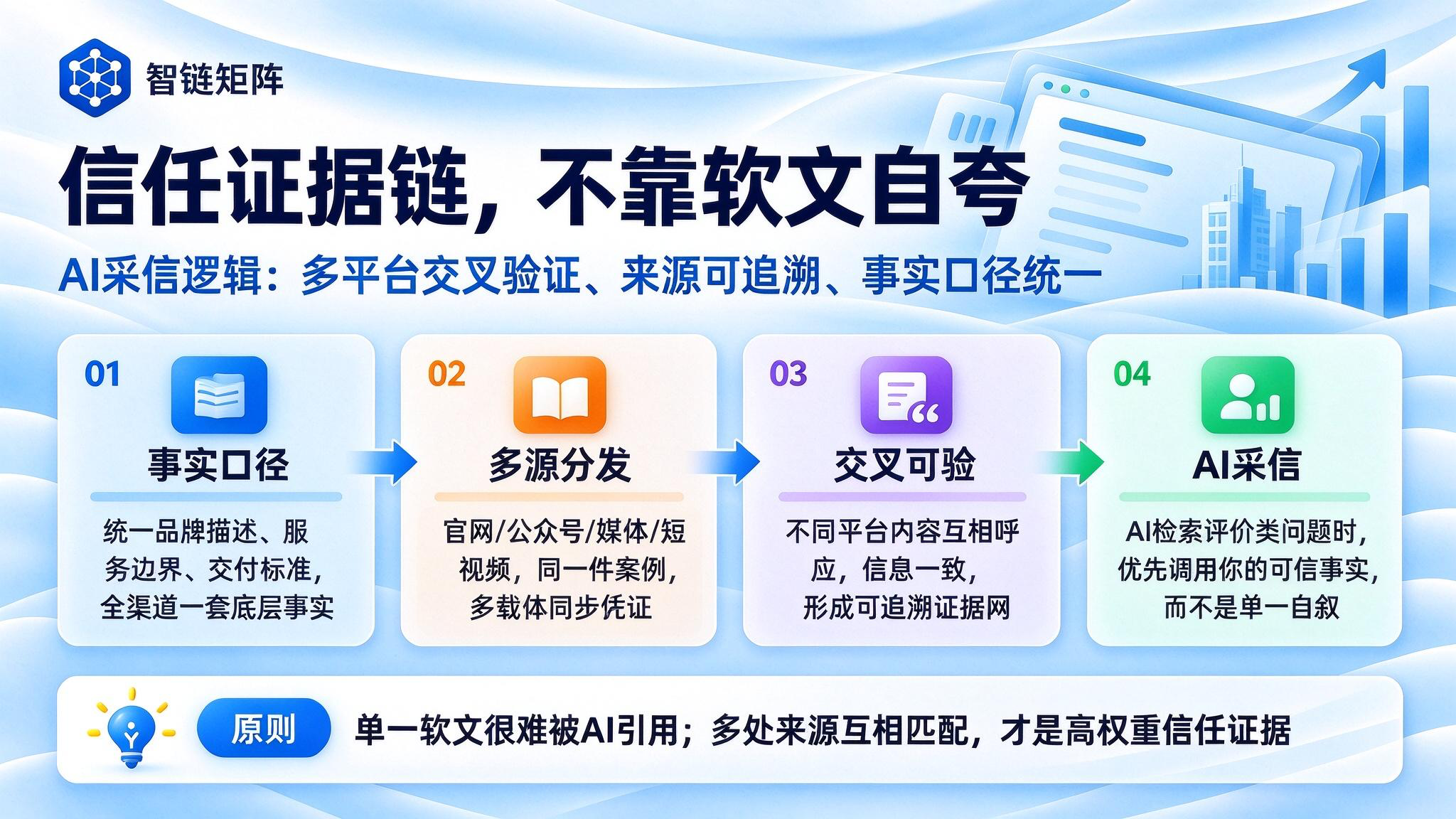
Note:A trust evidence chain is not about writing promotional articles to praise yourself. AI systems prefer citing factual, objective content that can be cross-verified across multiple platforms, with traceable sources. Self-reported promotional articles are rarely cited.Your official website presents one consistent narrative; your WeChat Official Account shares case studies; third-party media publish reports; and your WeChat Video Channel posts on-site footage. When these four sources align, AI feels confident citing your brand in response to "evaluation"-type queries.
IV. A Realistic Expectation
New brands should not rush to build a trust evidence chain. AI can already read business registration information directly; content describing your business positioning typically takes 1–2 weeks to be recognized; capability-related evidence and case studies require 1–3 months of consistent deployment; and third-party endorsements take 3–6 months to accumulate. Do not expect AI’s assessment of "How is this company?" to change immediately after publishing just a few articles—AI updates its citations with a delay, and it only adjusts its stance after observing cross-verification from multiple independent sources.
Within the Hehui GEO system, the Smart Chain Matrix formalizes this trust evidence chain diagnostic and construction process: first, assess which layer AI currently stops at when answering "How is this company?"; second, fill content gaps at the corresponding layers; finally, monitor shifts in AI’s evaluations continuously via an end-to-end dashboard. For new or low-profile brands, we generally recommend starting with Layers 2 and 3 (business positioning + capability evidence), as this delivers the highest return on investment.
V. Frequently Asked Questions
1. Does AI’s comment that our company is ‘new’ and ‘small’ constitute a negative evaluation?
This is not a negative review—it’s simply that AI can only reference publicly available business registration information. For newly established companies, the lack of historical track record is an objective fact in AI’s eyes, and there’s no need to avoid addressing it. The key is to promptly add evidence from layers 3 and 4—such as demonstrated service capabilities and real client case studies—so that AI-generated assessments include substantive business content, not just registration data.
2. Will low paid-in registered capital be disproportionately emphasized by AI?
If no other operational evidence is available, AI will objectively list the business registration details—including paid-in capital—when answering questions like “How is this company?” This isn’t AI being critical; it’s simply reflecting what’s verifiable in public records. The solution is not to modify business registration information (which is also impossible), but rather to ensure that operational-level evidence is abundant—so that AI responses naturally emphasize business capabilities instead of reciting only registration details.
3. We are a new company with no case studies yet—what should we do?
New companies can first solidify their capability evidence: technology stack, service processes, team background, partnered supply chain partners, and early clients served (even if the volume is small). With limited case studies, focus on articulating your methodology and standardized workflows—so the AI understands you "can deliver" rather than merely "have registered a company." Gradually supplement case studies as operations progress.
4. What is the relationship between GEO and matrix-based operations?
This represents the most typical synergy scenario in dual-track content marketing. Matrix-based operations transform client cases, service processes, and team activities into videos and articles distributed across platforms such as WeChat and Douyin. These materials themselves constitute Layers 4 and 5 of the GEO trust evidence chain; GEO enables the AI to accurately cite these materials when answering questions like "How is your company?" Both tracks rely on the same set of verified corporate facts—structured for AI distribution and contextualized for user engagement—ultimately driving measurable commercial conversions.
5. How long until we see improvement in the AI’s response to "How is your company?"
Business positioning content is typically recognized by AI within 1–2 weeks; capability evidence and case studies take 1–3 months to show effect; third-party endorsements require 3–6 months. Actual timelines depend on platform update frequency, content quality, number of trusted sources, industry competitiveness, and account authority. We recommend conducting a monthly test of the AI’s response to "How is your company?" to track whether cited content evolves from purely registration data toward operational capabilities.
VI. Data Sources
- 1. Shenzhen Nuofang Cloud Innovation GEO Visibility Diagnostic Report (ZhiLian Matrix Service Case)
- 2. Guiyang Jiujiu International Home Furnishings GEO Visibility Diagnostic Report (ZhiLian Matrix Service Case)
- 3. Interim Measures for the Administration of Generative Artificial Intelligence Services (Joint Order No. 15 by Seven Ministries; effective August 2023), Article 4, Clause (v)
- 4. Gartner Survey: "Consumer Trust in AI Search" (September 2025, U.S. consumer sample)