
On November 6, 2026, the 'AI-Empowered Content Marketing Industry Exchange (Beijing)' event, organized by the School of Cultural and Creative Industries at Shanghai Jiao Tong University and co-organized by the Film & Celebrity Endorsement Committee of the China Advertising Association,AI-Empowered Content Marketing Industry Exchange (Beijing)was successfully held at the China Advertising Association.

When users want to learn about a celebrity, they may ask an AI search engine, “Which brands has he recently endorsed?” When users want to learn about a brand, they may ask an AI search engine, “What is this brand like?”How AI organizes publicly available information is becoming a new and important pathway for brands and endorsers to enter users’ awareness.
During AI search information audits for brands, we repeatedly observed the following situation: For the same endorsement collaboration, the official announcement page states “Brand Endorser,” the e-commerce page says “Brand Ambassador,” and news articles or encyclopedia entries mention only the brand name. As a result, AI-generated responses often produce contradictory relationship descriptions. Such issues typically stem not from missing content, but from inconsistent phrasing of the same fact across different pages.
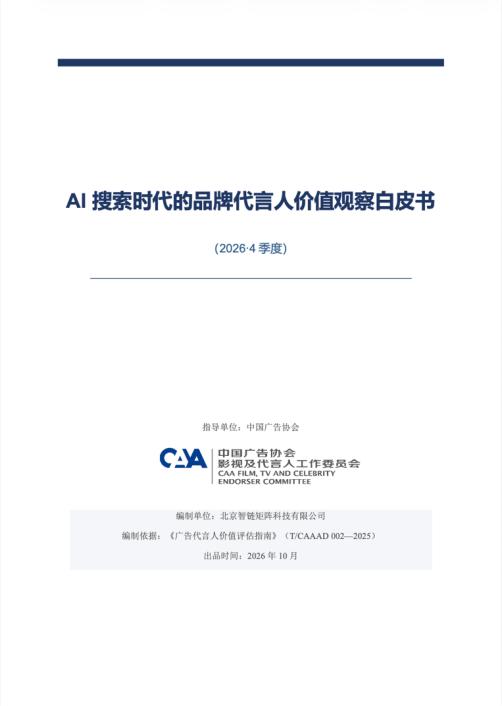
The White Paper on Brand Endorser Value Observation in the AI Search Era (Q4 2026) was compiled by Beijing Zhilian Matrix Technology Co., Ltd. and guided by the China Advertising Association. Based on publicly available case studies, the white paper examines behaviors of brands, celebrities, and fans, and outlines five noteworthy signals for the AI search era:
1. Shorter time gap between official announcement and commercial conversion
The white paper observes that, for some collaborations, the interval between official announcement and integration into product sales or offline experiences has shortened—resulting in promotional and commercial activities occurring concurrently. Rapid sell-outs or short-term sales data can capture consumers’ immediate reactions; however, a single sell-out record cannot directly reflect total sales volume, repeat purchase rates, or long-term partnership effectiveness. When evaluating endorsement performance, brands must distinguish among evidence of immediate conversion, sustained purchasing, and continued collaboration.
II. Whether the spokesperson participates in product decision-making serves as an indicator of collaboration depth
Some endorsement collaborations focus primarily on advertising exposure, while others involve the spokesperson in conceptual development, design, or content direction. The White Paper uses the co-branded collaboration between Liu Haoran and VICUTU as a case study, examining his involvement in areas such as thematic direction, visual symbols, and color palette. To determine whether a collaboration qualifies as co-creation, further questions may include: Which decision-making stages did the spokesperson participate in? Are these stages verifiable through publicly available information?
III. Title changes reflect the evolution of the partnership
The White Paper categorizes title changes into types including promotion, re-engagement, and category expansion. Examples include expanding the geographic scope of representation, renewing a prior collaboration, or extending cooperation from one product category to other categories within the same brand portfolio. Such information should clearly specify timing, region, title, and associated product line. Maintaining a visible timeline of collaborations on the brand’s official website and official social media accounts also helps users—and AI search tools—distinguish current endorsement relationships from past collaborations.
IV. Risk assessment requires distinguishing verified facts from unconfirmed rumors
The White Paper emphasizes that risk evaluation should prioritize authoritative sources, especially distinguishing matters officially confirmed by formal documents or official notices from unverified online discussions. As cited in the White Paper (page 4), the State Administration for Market Regulation published a representative case involving a live-streaming advertisement violation, where the advertiser was fined and had illegal gains confiscated totaling RMB 629,100, and spokesperson Wang Mou was separately penalized.
V. Boundaries are emerging for celebrity personal AI image licensing
The White Paper observes that celebrity images are being digitized and entering the licensing process: the same image carries different licensing scopes depending on its intended use and duration. Meanwhile, regulatory requirements for AI-generated content and image usage are tightening; brands must clearly specify the purpose, duration, and scope of use when licensing celebrity images to avoid unauthorized or out-of-scope usage.
CROSS Five Questions: Moving beyond exposure to assess partnership value
The WHITE PAPER proposes the CROSS Five Questions:
- Positioning Fit: whether the spokesperson aligns with the brand’s product category and brand tone;
- Audience Alignment: whether the spokesperson’s audience overlaps with the brand’s target demographic;
- Innovation Level: whether the collaboration delivers incremental value in product, design, or engagement approach;
- Cross-Community Reach: whether the campaign extends beyond the core fan base to reach broader audiences;
- Commercial Signal: whether the collaboration yields observable outcomes—such as sales lift, repeat purchases, contract renewals, or other measurable results.
The CROSS Five Questions originate from Chapter 3, 'Collaboration Analysis (CROSS Five Questions)' of the White Paper (pages 10–12). They are not a simple scoring checklist, but rather a framework for organizing evidence. Brands can use them to distinguish what official announcements, product involvement, market feedback, and long-term retention each indicate. The case studies and figures cited in the White Paper are based on their respective samples and statistical methodologies.
According to Liu Yagang, Executive Editor of the Beijing Zhilian Matrix "White Paper on Brand Spokesperson Value in the AI Search Era (Q4 2026)", "GEO4.0 focuses on brands’ long-term management of factual knowledge assets in the AI search era; CROSS Five Questions evaluates a brand’s specific co-branded collaboration with a celebrity or artist." Brands should first maintain accurate and consistent factual brand information, then use the CROSS Five Questions to assess a specific collaboration, and finally incorporate verified collaboration details into their overall brand information system. For brands, the criteria for evaluating spokesperson value are being redefined by publicly available factual information surfaced in AI search results.
Frequently Asked Questions
1. Why do AI search engines influence brand spokesperson decisions?
Users or fans may first learn about celebrities, brands, and their collaborations via AI. If the AI delivers outdated, incomplete, or inaccurate information, it may affect users’ understanding of the collaboration—and potentially skew brand teams’ assessments of spokesperson partnership information.
2. What are the CROSS Five Questions outlined in the white paper?
It examines brand–celebrity co-branding collaborations across five dimensions: alignment of positioning, audience fit, innovation level, cross-boundary communication impact, and commercial signals.
3. Do the cases and data in this white paper represent the entire industry?
No, they do not represent the entire industry. The white paper’s publicly disclosed observation sample—covering announcements, public reports, and publicly available data from August 2025 to September 2026, and including ten observed individuals across three sectors: performing arts, sports competition, and personal IP entrepreneurship—reflects only the situation within the specified observation period and scope.
Source of Information:
- White Paper on the Value of Brand Spokespersons in the AI Search Era (Q4 2026), guided by the China Advertising Association and compiled by Beijing Zhilian Matrix Technology Co., Ltd., October 2026.
- Compiled in accordance with the Advertising Spokesperson Value Assessment Guidelines (T/CAAAD 002—2025).
- Full version of the white paper is available on the official website of Beijing Zhilian Matrix Technology Co., Ltd. (www.zhilian.net.cn).